Container for catering
Beach snack bar, fixed food truck, mobile pizzeria, event bar, kitchen extension of an existing restaurant: the converted container is revolutionising mobile and lightweight catering. Prices, HACCP standards, equipment choices.
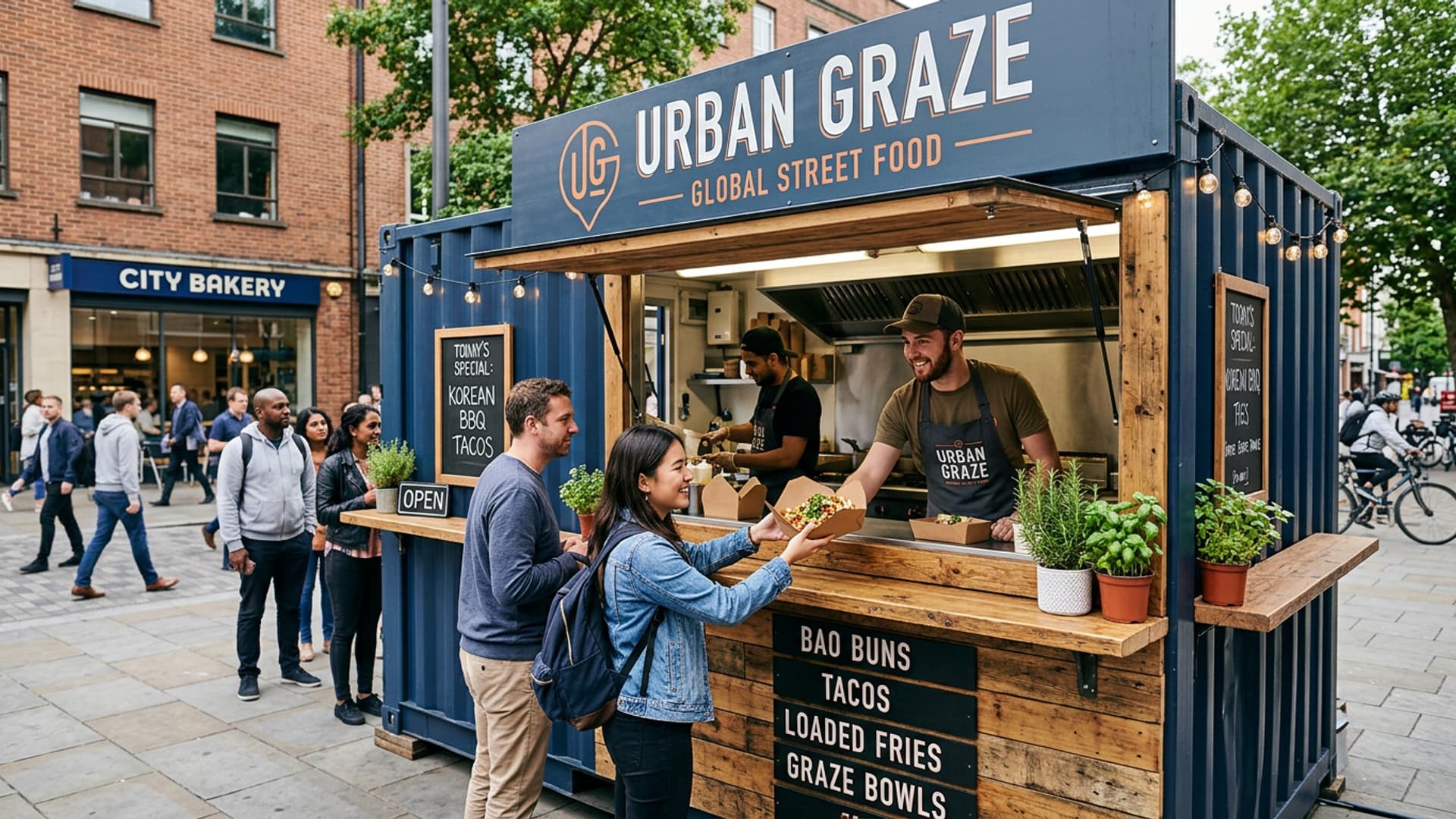
The 4 types of catering project
Snack kiosk (20 ft HC)
Ideal for beach, activity parking lot, promenade. Sandwiches, crepes, simple burgers, drinks. 1 operator. Budget £16,734 – £42,000 equipped.
Food truck kiosk (40 ft HC)
Pizzeria, burger, kebab, sushi, ambitious street food. Professional kitchen complete (hood 4m, grill, oven, pro fridge). 2-3 operators. £30,122 – £73,500 equipped.
Event bar
Hot and cold drinks service, beer tap, cocktails. Branding common. For festivals, concerts, trade shows. £16,734 – £57,750.
Existing restaurant extension
Click & collect dedicated area, kitchen extension, annex bakery-pastry workshop. Budget £13,388 – £42,000 (part of the equipment remaining in the main unit).
Equipment required for a complete project
- Extraction hood — mandatory when you use deep fryers, grills, or planchas. Sizing according to cooking surface. £2,100 – £5,250 installation included.
- Cold rooms / freezers — 1 positive room at 2-4 °C + 1 negative room at -18 °C required for traceability. £3,150 – £8,400 based on capacity.
- Stainless steel worktops — to HACCP standards (rounded corners, sealed fixings). £840 – £3,150 according to length.
- Hot and cold water supply + drainage — connection to the network or tank + wastewater recovery tank if site is isolated. £525 – £3,150.
- 32 A three-phase electricity minimum — In the United Kingdom, prepare HACCP-based food safety procedures, training appropriate to staff duties, and the registration or approval required for the activity. Consult: local authority; Food Standards Agency / Food Standards Scotland. A container manufacturer cannot alone certify the compliance of the food business. Register the food business with the local authority at least 28 days before trading. Registration is free; some activities involving products of animal origin require approval instead. Staff must receive instruction and training suitable for their work. Consult the Food Standards Agency for England, Wales and Northern Ireland, or Food Standards Scotland; inspection and rating arrangements differ. Estimates to confirm locally: £2,100 – £5,250.
- Propane gas (optional) — for flame cooking. Tank 500 L + installation to code. £1,575 – £3,150.
- Lighting and ventilation — LED interior + exterior, MVHR meeting ERP standards if public access. £840 – £2,625.
- Cash register and payment system — POS terminal, touch screen cash register, customer display screen. £1,575 – £4,200.
Food safety: five practical steps
In the United Kingdom, prepare HACCP-based food safety procedures, training appropriate to staff duties, and the registration or approval required for the activity. Consult: local authority; Food Standards Agency / Food Standards Scotland. A container manufacturer cannot alone certify the compliance of the food business. Register the food business with the local authority at least 28 days before trading. Registration is free; some activities involving products of animal origin require approval instead. Staff must receive instruction and training suitable for their work. Consult the Food Standards Agency for England, Wales and Northern Ireland, or Food Standards Scotland; inspection and rating arrangements differ.
Local regulations
In the United Kingdom, prepare HACCP-based food safety procedures, training appropriate to staff duties, and the registration or approval required for the activity. Consult: local authority; Food Standards Agency / Food Standards Scotland. A container manufacturer cannot alone certify the compliance of the food business. Register the food business with the local authority at least 28 days before trading. Registration is free; some activities involving products of animal origin require approval instead. Staff must receive instruction and training suitable for their work. Consult the Food Standards Agency for England, Wales and Northern Ireland, or Food Standards Scotland; inspection and rating arrangements differ. Estimates to confirm locally: £210 – £420.
Step 2 — Declaration of Activity to the Environmental Health Officer
In the United Kingdom, prepare HACCP-based food safety procedures, training appropriate to staff duties, and the registration or approval required for the activity. Consult: local authority; Food Standards Agency / Food Standards Scotland. A container manufacturer cannot alone certify the compliance of the food business. Register the food business with the local authority at least 28 days before trading. Registration is free; some activities involving products of animal origin require approval instead. Staff must receive instruction and training suitable for their work. Consult the Food Standards Agency for England, Wales and Northern Ireland, or Food Standards Scotland; inspection and rating arrangements differ.
Step 3 — Sanitation Control Plan (SCP)
Mandatory document formalising your good practices: cleaning plan, product traceability, temperature logs for cold rooms (at least twice a day), pest control, waste management, staff training. To be kept up to date and presented during any inspection. Official templates available on the Hygiene Good Practices Guide (GBPH) of the sector.
Step 4 — Equipment and fit-out compliance
Separation of clean and dirty traffic flows, hot and cold water taps with non-manual controls (foot pedal or elbow), dedicated hand washing sink, smooth and washable surfaces, positive cold room temperature range 0-4 °C and negative -18 °C, dry storage area, wastewater disposal to standards. Require HACCP compliance from the manufacturer at delivery — this must be explicitly stated in the quote.
Step 5 — Environmental Health Officer Inspection (first year then randomly)
In the United Kingdom, prepare HACCP-based food safety procedures, training appropriate to staff duties, and the registration or approval required for the activity. Consult: local authority; Food Standards Agency / Food Standards Scotland. A container manufacturer cannot alone certify the compliance of the food business. Register the food business with the local authority at least 28 days before trading. Registration is free; some activities involving products of animal origin require approval instead. Staff must receive instruction and training suitable for their work. Consult the Food Standards Agency for England, Wales and Northern Ireland, or Food Standards Scotland; inspection and rating arrangements differ.
Annual Operational Costs to Anticipate
Beyond the initial cost of a fitted-out container (£167,343,750 – £115,500), operation generates recurring expenses. Rough estimate for a 20 ft refrigerated retail unit:
| Item | Annual Range | Comment |
|---|---|---|
| Electricity (pro) | £2,520 – £5,040 | Professional fridge + oven + hood + lighting |
| Propane gas (if flame cooking) | £630 – £2,100 | Variable depending on cooking volume |
| Water + drainage | £315 – £945 | Higher if self-contained tank needs emptying |
| Hood maintenance + degreasing | £315 – £630 | Checks and maintenance according to activity and equipment; no universal annual certificate. |
| Cooking equipment inspection | £210 – £525 | Oven, griddle, deep fryer |
| Pest control / disinfection | £315 – £630 | HACCP procedures and monitoring suited to the activity; external service where needed, without a universal annual contract. |
| Small equipment renewal | £525 – £1,575 | Knives, plates, small utensils |
| Professional liability insurance + breakage | £630 – £1,575 | Based on equipment value and turnover |
| Public domain occupation | £0 – £6,300 | Very variable depending on municipality and location |
| Total fixed costs ≈ | £5,460 – £19,320/an | Excluding rent and personnel |
Price each item separately according to project, equipment, connections and included services. Model amounts are indicative; no fixed share of the complete budget is established.
Snack container or modular bungalow? 4 criteria to decide
For a fixed snack project, both solutions are viable. Neither the end customer nor the Environmental Health Officer inspector will make a difference in terms of activity — it's a budget decision, an aesthetic choice, and one about the business outlook.
| Criterion | Modular bungalow | Converted container |
|---|---|---|
| Initial fitted budget | £13,388 – £47,250 | £16,734 – £73,500 |
| Service life | 12-18 years | 25-40 years |
| Aesthetics / brand image | Standard, neutral | Strong industrial, street food, DNVB |
| Out-of-service intrusion resistance | Low (panel walls) | Very high (Corten steel) |
Our recommendation: site bungalow if budget is tight and project is short- to medium-term (< 5 years, seasonal activity, concept testing). Shipping container if you aim for a permanent project, strong brand image, or resale in 5-10 years (the shipping container retains its value better). For secure off-season tourist location (beach, resort), the shipping container excels in intrusion resistance.
Frequently Asked Questions — Catering Sector
Is a snack container compliant with HACCP standards?+
Yes, provided that the fit-out is designed for compliance. Proper/sanitary separation, dedicated preparation zones, hot and cold water points, waste water disposal, adequate refrigeration, ventilation/hood sizing. Specialised snack container manufacturers generally deliver to standard specifications. A Environmental Health Officer inspection can verify at any time — request the manufacturer's certification upon purchase.
What is the cost of a fitted-out snack container?+
Entry-level (cold sandwiches, drinks): £16,734 – £42,000. Full range (pizza, burger, kebab) with hood, grill, fridge, freezer, stainless steel worktop: £30,122 – £73,500. Premium range (high-end finishes, double service façade + rear preparation area): £46,856 – £115,500. Excluding land costs and connections (water, electricity 32 A minimum three-phase, waste water).
Can a snack container be placed next to an existing restaurant to extend capacity?+
Yes, this is common practice. The shipping container serves as a kitchen extension or takeaway point of sale (click & collect). Lower budget (£13,388 – £36,750) since some equipment remains in the existing kitchen. Note: administrative process (pre-notification or permit) required based on surface area and consultation with safety services (SSI) for public reception establishments.
What about a fixed food truck versus a traditional mobile one?+
A traditional food truck (mobile vehicle) costs £42,000 – £84,000 equipped. A fitted-out snack container placed as a fixed food truck costs £16,734 – £73,500 for equivalent equipment. Advantages of the fixed container: larger interior space, lower cost, less mechanical maintenance (no engine). Disadvantage: no permanent mobility. Choose based on your business model.
What is the minimum surface area required to operate a catering shipping container?+
A converted high cube 20-foot shipping container offers ~14 m² of usable space — sufficient for a simple snack operation with one operator and fast service flow. A converted high cube 40-foot (~28 m²) allows a full takeaway restaurant for two to three operators with a rear preparation area + front counter. For modern fixed food trucks, the 40-foot HC has become standard.
Also worth seeing
Converted container
Pillar : steps, trades, pitfalls, transformation budgets.
HACCP food truck
In the United Kingdom, prepare HACCP-based food safety procedures, training appropriate to staff duties, and the registration or approval required for the activity. Consult: local authority; Food Standards Agency / Food Standards Scotland. A container manufacturer cannot alone certify the compliance of the food business. Register the food business with the local authority at least 28 days before trading. Registration is free; some activities involving products of animal origin require approval instead. Staff must receive instruction and training suitable for their work. Consult the Food Standards Agency for England, Wales and Northern Ireland, or Food Standards Scotland; inspection and rating arrangements differ.
Events Sector
Mobile bar, festival snack, artist dressing rooms : configurations.