Industrial shipping container
Mobile workshop, ISO cleanroom, parts storage, production line backup, temporary laboratory: the industrial container offers unbeatable flexibility and cost compared to traditional buildings while meeting the strictest technical requirements.
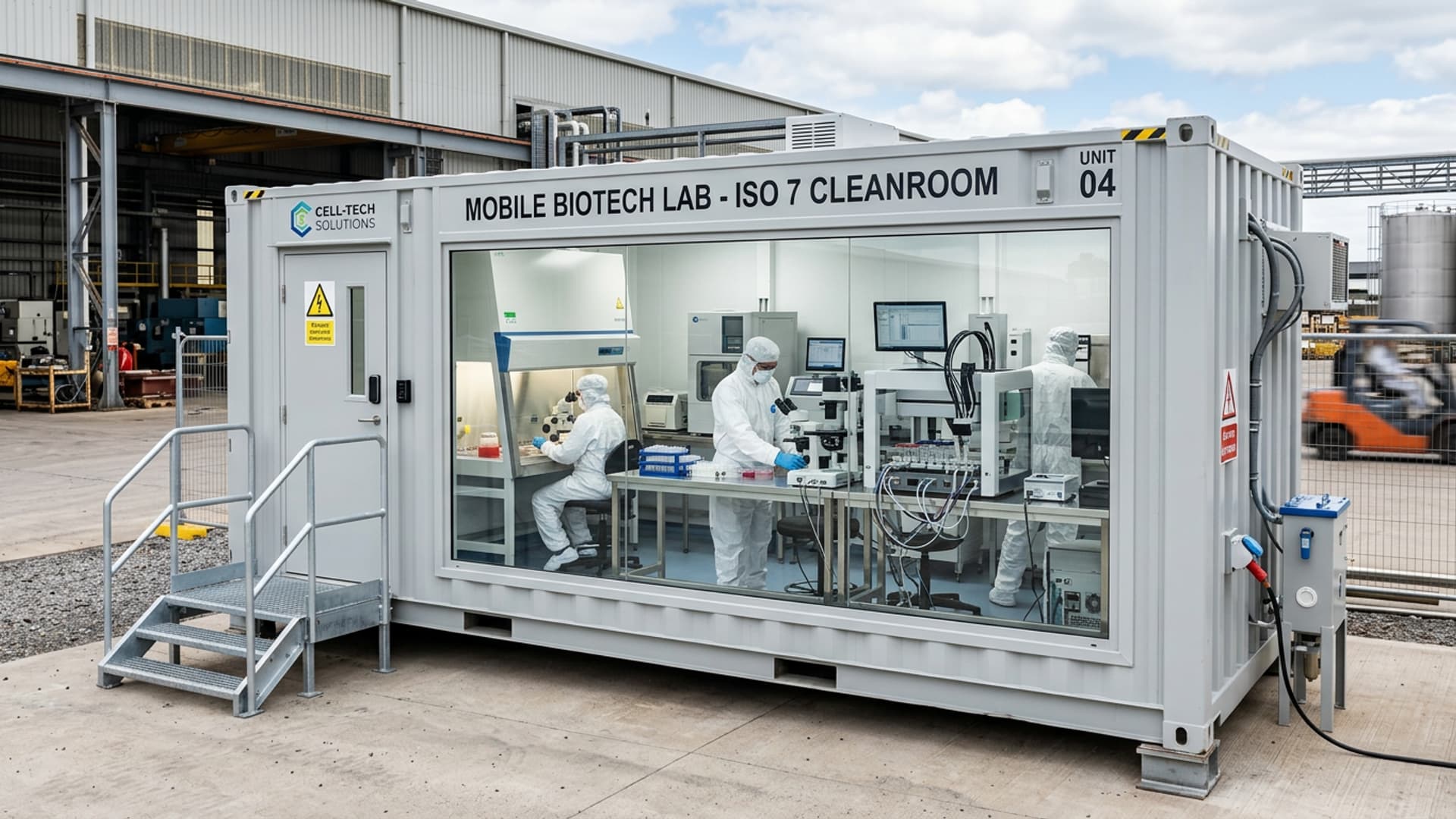
The 3 typical industrial configurations
Mobile workshop
40 ft HC equipped with workbenches, lathes, drills, tools. For offshore maintenance, aerospace, rail. £26,250 – £84,000 investment fully equipped.
Cleanroom container
ISO class 5 to ISO 8 clean room with HEPA/ULPA filters, overpressure, inert coatings. £47,250 – £157,500 according to targeted class and integrated control equipment.
Micro-production line
Light assembly, small biotech volume, artisanal cosmetics, specialised agri-food. 20 ft or 40 ft depending on flow. Concept validation before final building.
Why a shipping container rather than a new building?
- Deadline — 8-12 weeks vs 12-24 months for a traditional brick-built industrial building (permits, tendering, construction site, inspections).
- Total cost — 30-50 % cheaper than an equivalent brick-built structure, especially for limited surface areas (< 60 m²).
- Mobility — move a mobile workshop or cleanroom according to projects, something impossible with a fixed building.
- Demountability — at the end of contract or project: the container is taken back by the supplier or resold. A brick-built structure remains there and must be demolished (additional cost).
- Taxation — the container is generally depreciated over 5-10 years (vs 30 years for a building). Softer cash flow.
- Test / pilot — validate a production line or process before investing in a real production site. Drastically reduces industrial risk.
Frequently Asked Questions — Industrial Sector
Can a container be used as a cleanroom (white room)?+
Yes, this is a rapidly growing use. A 40-foot high cube container is converted with HEPA/ULPA filters, regulated overpressure, inert coatings (continuous PVC), dedicated lighting. Depending on the targeted ISO class (ISO 8 to ISO 5), costs range between £47,250 – £157,500. Advantages over traditional cleanrooms: short lead time (8-12 weeks), mobility, reduced cost by 30-50%.
Which industries use containers as mobile workshops?+
Oilfield maintenance, offshore operations, aerospace (site cable assembly workshop), rail, marine (port workshop), wind energy (isolated wind farm construction sites). Typical usage: a workshop equipped according to the project, then dismantled and moved on to the next one. Initial investment £26,250 – £84,000 depending on tools and integrated equipment.
Can production lines be installed in containers?+
Yes for compact lines: micro-industries (artisanal cosmetics, small biotech volume, specialised food, 3D printing), light assembly, quality control. The limited space (33 m³ in a 20-foot container) requires flow optimisation. A very interesting solution to validate an industrial concept before investing in permanent infrastructure.
Can a container serve as backup room for production lines?+
Absolutely. Common use in agri-food and pharma: a reefer or technical module kept on standby, ready to take over from a failed cold storage unit or absorb peak production. Mid-term rental (3-12 months) billed monthly, quick dismantling once the crisis is resolved.
What is the useful electrical capacity?+
A container can accommodate a standard three-phase electrical panel rated at 32 A (22 kW available power), sufficient for most light workshops. For heavy equipment (machine tools, cleanroom with powerful air conditioning), a three-phase connection of up to 63 A or even 125 A is possible (specific Enedis connection, 2-6 weeks lead time). Allow £2,100 – £8,400 for connection depending on distance from the network.