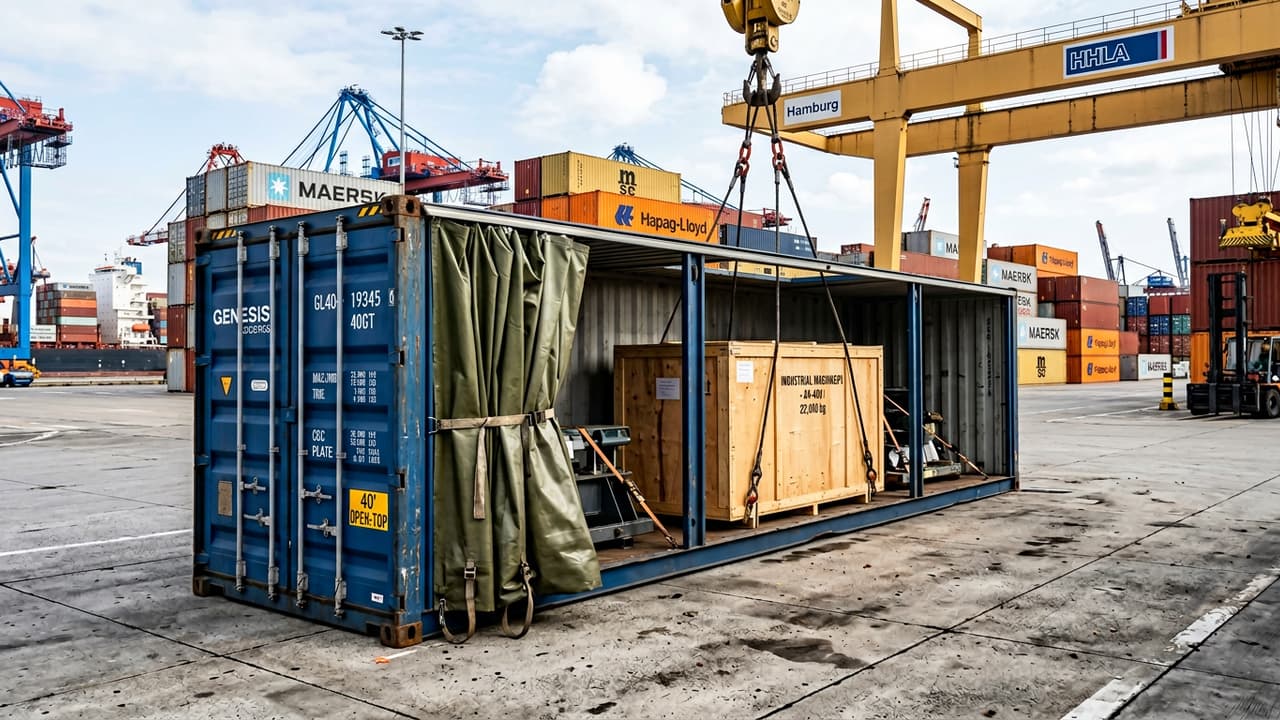
Open top container: when loading is done from the top
The open top is a 20 or 40-foot container where the rigid roof is replaced by a removable tarpaulin. The difference may seem minor — it radically changes usage cases: crane loading, over-height loads, parts that refuse to enter through rear doors. Complete guide.
Key Features
- External length
- 6,058 m
- External width
- 2,438 m
- External height
- 2,591 m
- Internal Height
- 2,348 m
Dimensions and capacity
| Characteristic | 20 feet open top | 40 feet open top |
|---|---|---|
| External length | 6,058 m | 12,192 m |
| External width | 2,438 m | 2,438 m |
| External height | 2,591 m | 2,591 m |
| Internal Height | 2,348 m | 2,348 m |
| Roof opening | 5,65 × 2,23 m | 11,77 × 2,23 m |
| Internal volume | ~32 m³ | ~65 m³ |
| Payload capacity | ~21 t | ~26 t |
Three situations where the open top is essential
- Over-height loads — machinery, pipes, wind turbine blades, civil engineering parts that exceed 2.30 m: the tarpaulin folds back, cargo exits from above, transport height remains at 4.20 m.
- Mandatory crane loading — crushed stone in bulk, steel coils weighing 3 to 8 tonnes, raw timber logs, pallets too heavy for manual pallet jacks: the roof is opened, cargo is poured or placed.
- Bulk poured from above — minerals, aggregates, sorted construction waste, non-food grains. The tarpaulin closes to protect against wind and rain during transport.
- To avoid for — long-term storage of moisture-sensitive goods (paper, textiles, electronics). The tarpaulin ages, a rigid roof remains safer after 10 years.
Frequently Asked Questions
What exactly is an open top container?+
A standard shipping container (20 or 40 feet) with the rigid roof replaced by a reinforced PVC cover, mounted on a removable frame. The rest of the structure (walls, floor, rear doors) remains identical to a standard container. The cover can be detached for overhead loading, typically using a crane.
Which uses are best suited for an open top container?+
Three main cases dominate. 1) Loads exceeding the height of the rear doors: machine tools, pipes, wind turbine blades. 2) Crane loading when side access is not possible: quarry stones, steel coils, raw timber logs. 3) Storage or transport of bulk materials poured from above: ore, non-food grains, construction waste.
What are the dimensions for a 20-foot and a 40-foot open top container?+
20 feet : 6,058 m × 2,438 m × 2,591 m exterior, 5,898 × 2,352 × 2,348 m interior (the usable height is the same as a standard container when the cover is in place). 40 feet : 12,192 × 2,438 × 2,591 m exterior. Roof opening: ~5,65 m × 2,23 m on a 20'; ~11,77 × 2,23 m on a 40'. Payload capacity: 21 to 26 tonnes depending on model.
How much does an open top container cost in 2026?+
Grade A used : 20 feet £2,940 – £3,780, 40 feet £3,990 – £5,040. Grade B : 20 feet £2,310 – £2,940, 40 feet £3,360 – £4,095. Brand new/one-trip : 20 feet £3,990 – £5,250, 40 feet £5,460 – £7,140. New spare cover : £473 – £945 depending on format. Less common in stock than a standard container: expect 3 to 6 weeks delivery time outside of catalogue.
Is the tarpaulin waterproof over time?+
At purchase yes, the reinforced PVC cover resists rain and UV rays. With intensive use (frequent opening/closing, sun exposure), expect a useful life of 5 to 8 years before replacement. For long-term static storage of moisture-sensitive goods, a standard container with a rigid roof is preferable.
Can an open top be rented instead of purchased?+
Yes, but the offer is more limited. Typically £126 – £231/month for a used 20', £189 – £336/month for a used 40'. Relevant for a one-off construction site with crane loading. For needs ≥ 18 months, buying second-hand is often more economical.
Need an open top?
5 quotes compared in 48 h, verified suppliers, delivery throughout the UK.