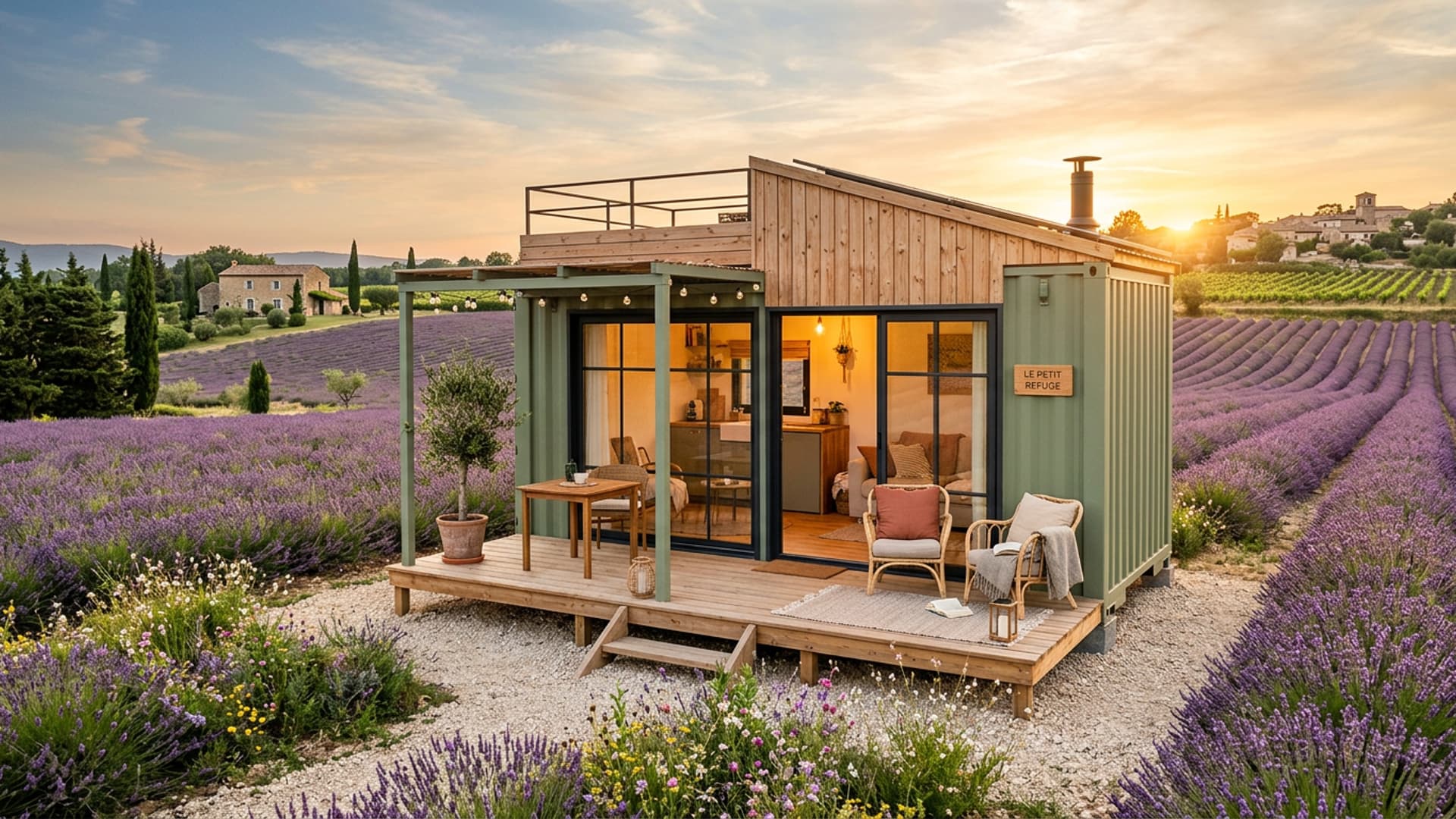
Tiny house container : living in a shipping container
From the garden studio of 20 feet to the family home of three modules, the shipping container has become a real alternative for compact, modern and economical housing. What you need to know before starting: actual prices, standard plans, regulatory points, pitfalls to avoid.
Three standard plans
Studio 1 module
1 × 40 feet high cube. 28 m² gross, 23-24 m² habitable after insulation. Living room + kitchenette + bathroom + sleeping area. Ideal for single person, holiday cottage, residential office.
£29,400 – £57,750
T2 two modules
2 × 40 feet HC joined together. 56 m² gross, 48-50 m² habitable. Living room + kitchen + bedroom + bathroom. Format for couples, second home, Airbnb rental.
£57,750 – £99,750
Family Home 3-4 Modules
3 or 4 × 40 ft HC, potentially on two levels. 80 to 120 m² of living space. Living room, kitchen, 2-3 bedrooms, 2 bathrooms. Main family residence.
£99,750 – £189,000
The 5 Key Decisions for Your Project
- Number of Modules. Start with the targeted living space area, multiply by 1.2 (for insulation loss), then divide by 28 to determine the number of 40 ft HC containers needed. Allow extra space for circulation.
- Brand New or One-Trip Containers. For housing, never use Grade B or C used containers. Brand new for a perfect showcase, one-trip to save 15-20%.
- Interior or Exterior Insulation. Interior: faster, cheaper, but thermal bridge management is required. Exterior: Building Regulations Part L compliant and more expensive, requires cladding. Exterior insulation is preferred for permanent housing.
- Foundation Type. Concrete slabs (easy, demountable), perimeter longline (balance), concrete slab (most stable, but fixed habitation). Choose according to your tolerance for future relocation.
- Architect required or not. Mandatory beyond 150 m² of floor area. Strongly recommended from 2 modules onwards for structural validation and robust building permit. Fees range from 8% to 12% of construction costs.
Frequently Asked Questions
Can one really live in a shipping container on a daily basis?+
Yes, provided you choose the right format and do not skimp on insulation. A 40-foot high cube offers 28 m² of floor space and 2.70 m of interior height before insulation — equivalent to a good studio apartment. For a couple, two modules side by side (56 m²) offer a very comfortable T2 flat. According to our estimates, more than 3,000 people in France today live in container houses as their primary residence.
How much does a tiny house shipping container cost?+
Single module 40-foot HC converted into studio (28 m² of living space): £29,400 – £57,750 turnkey. Two-module T2 version (56 m²): £57,750 – £99,750. Family version with 3-4 modules T3/T4 (80 to 120 m²): £99,750 – £189,000. Excluding land, connection costs (£4,300 to £13,000), taxes and potential fees. At equivalent surface area, it is 15% to 25% cheaper than a traditional brick-built house.
Is this really a 'tiny house'?+
A tiny house in the strict sense refers to a mobile dwelling (on trailer) of less than 20 m². A container home of 28 m² is therefore technically more than a tiny house — we refer rather to an ‘ultra-minimalist’ habitat. For a genuine rolling tiny house, a 20-foot container can be mounted on a flatbed trailer, with weight and road width constraints (maximum height of 3.50 m when towed, standard not high cube).
What regulations apply to a tiny house shipping container?+
Identical to any residential construction. Surface area > 20 m² = building permit required. Connection to utilities or autonomous system (water, sewage, electricity). Compliance with local PLU zoning rules. Development tax. Building Regulations Part L for thermal performance. A tiny house on wheels that remains on a site for more than three months is considered construction and falls under the same regulations.
Is insulation really the critical point?+
Yes. An uninsulated container becomes an oven in summer (interior at 45 °C with exterior temperature of 30 °C) and a freezer in winter. For habitation, minimum requirement: 80 mm of sprayed polyurethane to walls and ceiling, 50 mm under the floor. Budget £4,725 – £8,400 for a 40 ft HC. Never insulate 'internally with glass wool panels' without thermal bridge break — classic mistake that generates condensation and mould.
Can a tiny house container be moved once installed?+
Yes, if it is placed on concrete blocks or sleepers (not on a full slab). Dismantle connections, load by crane onto flatbed truck, transport, reinstall. Cost: £1,575 – £4,200 per trip for one module. For multiple assembled modules, the assembly must be disassembled, which becomes more complex. Plan from conception if mobility is a criterion.
Your tiny house container project
5 quotes from specialists in container transformation.