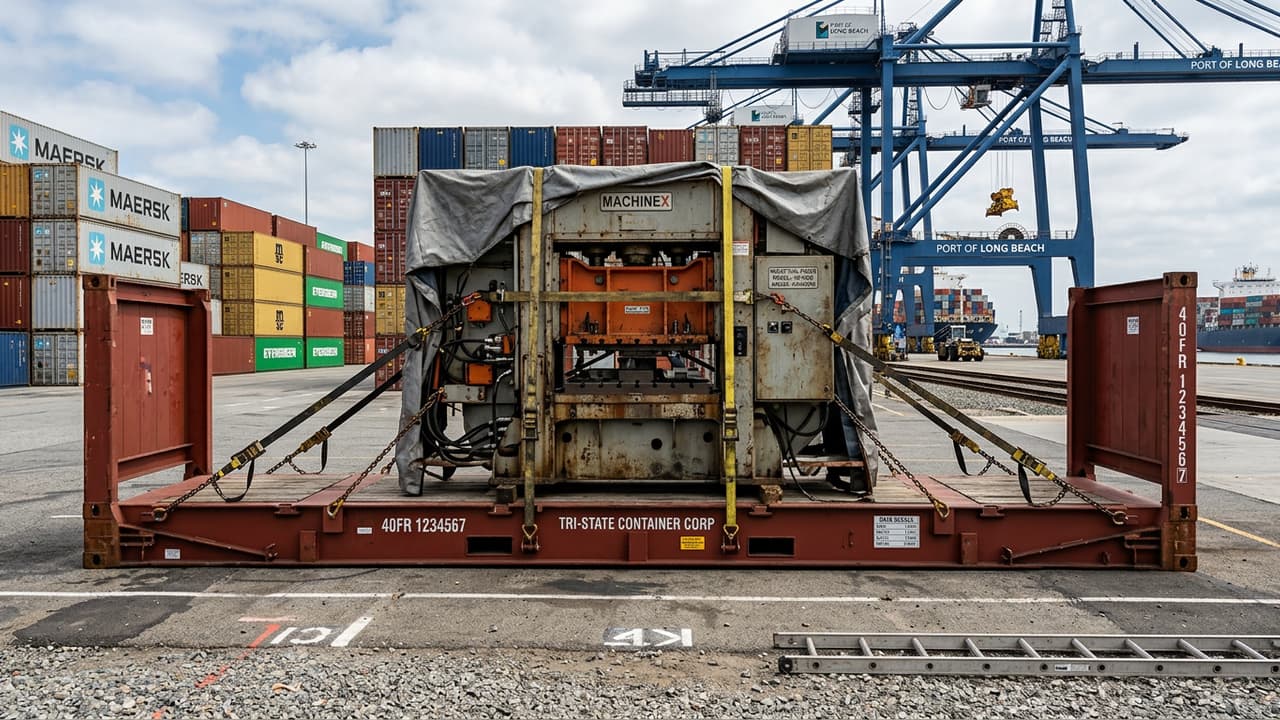
Flat rack: the platform for impossible loads
The flat rack is not really a shipping container — it's an ISO platform with two end walls. No roof, no sides, no doors. Load, secure, transport. Designed for what won't fit anywhere else: vehicles, machinery, pipes, coils, propellers. Up to 45 tonnes of payload.
Key Features
- External length
- 6,058 m
- External width
- 2,438 m
- External height
- 2,591 m
- Useful platform
- 5,94 × 2,35 m
Dimensions and capacity
| Characteristic | 20 feet flat rack | 40 feet flat rack |
|---|---|---|
| External length | 6,058 m | 12,192 m |
| External width | 2,438 m | 2,438 m |
| External height | 2,591 m | 2,591 m |
| Useful platform | 5,94 × 2,35 m | 12,08 × 2,40 m |
| Wall height | 2,23 m | 2,23 m |
| Maximum payload | ~30 t | ~45 t |
| Versions | Fixed or collapsible | Fixed or collapsible |
Typical use cases
- Industrial machinery — presses, lathes, generators, compressors whose width or shape exceeds the dimensions of a dry container.
- Vehicles and equipment — cars (×2 in chevron formation on a 40'), tractors, mini excavators, scooters, small boats and yachts on cradles.
- Long loads — pipes, steel beams, masts, short wind turbine blades: they are placed lengthwise, overhangs at the ends managed by exceptional transport.
- Concentrated heavy loads — marble, forged parts, steel coils weighing several tonnes: reinforced floor that can handle 40 to 45 t depending on the model.
- To avoid for — goods sensitive to humidity or theft. The flat rack is not a storage solution: its value lies in transport.
Frequently Asked Questions
What is a flat rack, in one sentence?+
An ISO-sized platform (20 or 40 feet) equipped with only two end walls — no roof, no sides, no doors. Goods are placed on top and secured. Designed for loads that won't fit into any other container due to width, height, or shape.
Fixed or collapsible: what's the difference?+
On a fixed flat rack, the two end walls are welded to the platform — simple, sturdy, but takes up full volume when empty. On a collapsible one, the walls fold down flat onto the platform: four folded collapsible racks fit in the space of one standing container, reducing maritime repositioning costs by three or four times. The majority of the pro market is collapsible.
What types of loads are suitable?+
Anything that won't fit into a standard container. Vehicles (cars, tractors, small boats), heavy and industrial machinery (presses, generators, compressors), long pipes, large steel coils, marble, prefabricated metal structures, propellers, medium-sized yachts. Up to 40 to 45 tonnes depending on the model — far beyond a standard dry container.
What dimensions for a 20 and a 40 feet flat rack?+
20 feet: 6,058 m × 2,438 m × 2,591 m exterior, usable platform 5,94 × 2,35 m. 40 feet: 12,192 × 2,438 × 2,591 m exterior, usable platform 12,08 × 2,40 m. The end walls are approximately 2,23 m high, but the load can exceed this height (out-of-gauge) — in such cases, exceptional transport charges apply separately.
How much does a flat rack cost in 2026?+
Used: fixed 20 feet £3,360 – £4,725, collapsible £4,200 – £5,775. Fixed 40 feet £5,040 – £6,825, collapsible £6,090 – £8,400. Brand new/one-trip: collapsible 40 feet £8,925 – £13,125. Stock is more limited than for a dry container: expect a lead time of 2 to 6 weeks. Not typically in stock with general suppliers — go through a shipping specialist or comparison site.
Can a flat rack be used on land for storage?+
Not relevant. Without a roof or walls, it offers no protection against the elements or theft. Its advantage is transport — for storage, a standard dry container or open top would always be more suitable. Except in very specific cases: placing heavy loads outdoors in an enclosed warehouse without securing them to the ground.
Need a flat rack?
5 quotes compared in 48 h, verified suppliers, delivery throughout the UK.