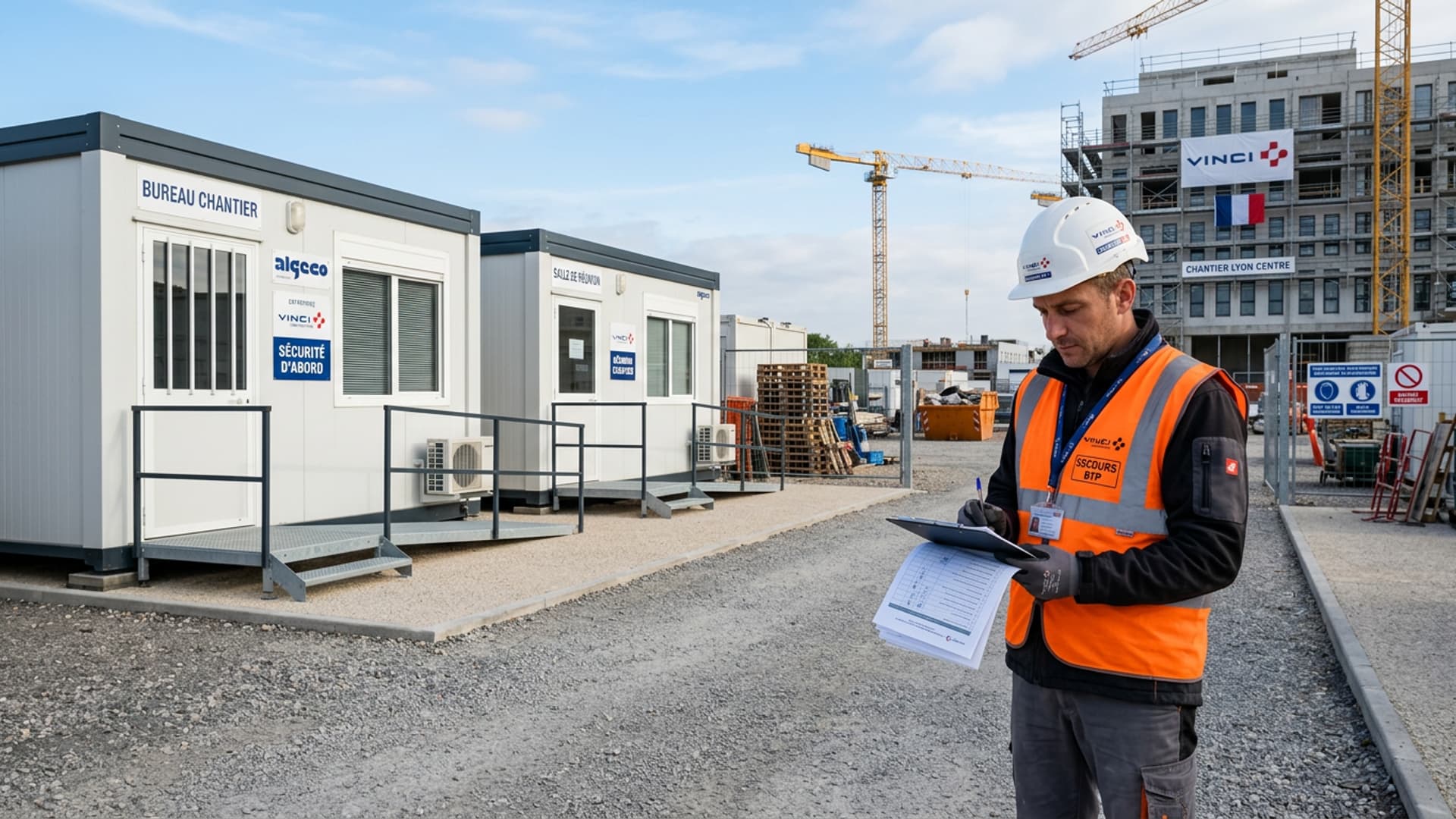
Site accommodation unit and site bungalow: the guide for construction industry professionals
Drying rooms, toilets, offices, canteens: every UK contractor opening a site must provide welfare facilities under the Construction (Design and Management) Regulations 2015. We cover the units, 2026 prices, the regulatory baseline, and the question every site manager asks — hire or buy when you run back-to-back projects.
What CDM 2015 actually requires
As soon as a contractor employs a worker on a construction site, welfare facilities must be made available under Schedule 2 of the Construction (Design and Management) Regulations 2015 (CDM 2015), enforced by the Health and Safety Executive (HSE) and local authorities. Below is the legal minimum, no fluff:
- Sanitary conveniences (Sch.2 §1) — Suitable and sufficient sanitary conveniences must be provided or made available, kept clean, with adequate lighting and ventilation. Separate facilities for men and women where reasonably practicable, or rooms with lockable doors usable by one person at a time.
- Washing facilities (Sch.2 §2) — Hot and cold (or warm) running water, soap, towels or other suitable means of drying. Adjacent to sanitary conveniences and changing rooms. Showers required where the work is dirty or involves hazardous substances (asbestos, demolition, ground works).
- Drinking water (Sch.2 §3) — Adequate supply of wholesome drinking water at readily accessible and suitable places, clearly marked. Cups or other drinking vessels unless the supply is from a fountain.
- Changing rooms and lockers (Sch.2 §4) — Required where workers must wear special site clothing and where it isn't appropriate for them to change elsewhere. Separate by gender, secure storage for personal clothing not worn during work and for work clothing not taken home, plus a means of drying wet clothing.
- Facilities for rest (Sch.2 §5) — Suitable and sufficient rest facilities including arrangements for non-smokers to be protected from tobacco smoke, seating and tables, means to prepare and eat meals (kettle, microwave), means of boiling water. Pregnant workers and nursing mothers must have somewhere to rest lying down.
- Maintained and accessible from start of works — Welfare facilities must be in place from day one — not 'as soon as practicable'. The principal contractor (CDM 2015 reg. 13) is responsible for ensuring they are maintained throughout the project.
HSE inspectors and Local Authority EHOs can issue Improvement Notices or Prohibition Notices for non-compliant sites. Breach of Section 33 of the Health and Safety at Work etc. Act 1974 carries unlimited fines in the Crown Court (up to £20,000 per offence in the Magistrates' Court) and up to 2 years' imprisonment for individuals. The principal contractor is jointly liable.
The Four Basic Modules
Here is what our supplier partners most often offer, with price ranges for 2026. Prices vary according to interior equipment, insulation level, and rental duration.
Construction Site Office
Equipped module: desk, chair, heating, lighting, sockets, window. For the site manager, master craftsman, construction meetings. Surface area 7 to 15 m².
£231 – £399/month in rent, £4,725 – £12,600 to purchase
Collective Changing Room
Benches, secure metal lockers, heating, lighting. Sized to site headcount with at least one locker per worker (CDM 2015 Sch.2 §4). Drying area for wet PPE and outerwear.
£263 – £441/month in rent, £5,775 – £14,700 to purchase
Toilets / shower
WC, washbasin, shower depending on module. Water connection and drainage required. Some modules are autonomous (integrated tanks) for non-connected zones.
£294 – £504/month in rent, £6,825 – £18,900 to purchase
Canteen
Tables, chairs, kettle, sink with potable water, microwave. Required as soon as workers eat on site (CDM 2015 Sch.2 §5). Non-smoking, away from work zones, suitable for pregnant workers/nursing mothers.
£273 – £462/month in rent, £6,300 – £16,800 to purchase
Site cabin or converted shipping container?
Historically, site accommodation was done in modular bungalows (light steel structure with metal cladding and insulated sandwich panels). In recent years, an alternative has emerged: the converted shipping container. Honest comparison:
| Criterion | Classic site cabin | Converted container |
|---|---|---|
| Purchase cost | £4,725 – £14,700 | £5,775 – £18,900 |
| Service life | 15 – 20 years | 25 – 40 years |
| Burglary resistance | Average (sheet metal) | Very high (Corten steel) |
| Resale Value | Low (30 % at 10 years) | High (60-70 % at 10 years) |
| Transport | Simple (flatbed truck) | Container carrier truck |
| Insulation | Integrated (sandwich panels) | To be done (£5,250 – £15,750) |
Summary verdict: the site cabin remains faster to deploy and cheaper upfront. The converted container is more durable, safer, and retains its value better — but it requires a higher initial investment and longer preparation work.
Our 5 practical tips for your site accommodation unit
- Anticipate connections. Water and electricity connections on construction sites are often underestimated. Expect 1 to 3 weeks for temporary Enedis connection (longer if the area is not covered), with costs ranging from £430 to £2,100 depending on distance to the network.
- Size just right, then add 20%. Construction sites last longer and employ more people than expected. A locker room sized exactly to capacity quickly becomes uncomfortable as numbers grow. An extra module is cheaper than a demotivated employee.
- Opt for stackable modules. On a constrained urban construction site, stacking bungalows (changing rooms on ground floor, offices upstairs) saves a lot of space. External stairs should be included in the package.
- Secure against theft. Construction sites are regular targets for tool burglaries. A site cabin in Corten steel container with lock-box and motion-detecting lighting is well worth its extra cost.
- Check the insurance. Does your professional liability insurance cover damage to rented modules? If not, subscribe to additional insurance (50 to £130/year per module).
A network of specialised construction industry rental providers
Our partner suppliers know your constraints: tight deadlines, difficult access, inspection requirements, temporary connections. All have at least two years' experience, clear geographical coverage, and a documented delivery procedure within 48 to 72 hours.
Frequently Asked Questions
What is the difference between a site cabin and a construction site bungalow?+
"Site cabin" is the regulatory term that refers to all social facilities on a construction site (changing room, toilet, canteen, office). "Bungalow" refers to the building itself — that is, the module. A site cabin therefore consists of one or more bungalows. In common usage, both terms are often used interchangeably.
From when is a site cabin mandatory on a construction site?+
From day one. The Construction (Design and Management) Regulations 2015 (Schedule 2) require: sanitary conveniences, washing facilities (hot and cold water, soap, drying), drinking water, changing rooms with lockers where site clothing is worn, and rest facilities (seating, kettle, microwave). Facilities must be in place from the start of works, not 'as soon as practicable'. The principal contractor is responsible. HSE inspectors enforce compliance.
What budget should be planned for a construction site cabin?+
For an average-sized construction site (10 to 20 workers, 12 months duration): plan £473 – £945/month for a changing room + toilet + small office set, excluding delivery (£263 – £525 round trip), excluding connections (water, electricity: £525 – £2,625). On sites lasting more than 24 months, buying often becomes more cost-effective than cumulative rental.
How are sanitary modules connected?+
Two options. Direct connection to the public network (drinking water + sewage disposal) when available: a plumber's visit, £315 – £840 on average. Or an autonomous module with recovery tanks (greywater / blackwater), emptied periodically by a specialised provider (£84 – £158 per emptying according to volume). Some modules combine both.
Are the site cabins insulated?+
Yes, almost all new or recent modules are insulated (mineral wool 50 to 80 mm, U = 0.5 to 0.7 W/m²K). Low-end used modules may have degraded insulation — check visually. Electric heating (convection heaters 1,000 to 2,000 W) is standard. For winter construction sites at high altitude, overdimensioning is recommended.
Can a shipping container be converted into a site cabin?+
Yes, it's actually very common. Converting a 20-foot container into a locker room or a 40-foot high cube into an office and dining area often offers better cost-quality than a new bungalow, especially for long-term construction sites. The conversion costs £8,400 – £21,000 depending on the level of equipment. Advantage: at the end of the project, you retain a resellable asset.
Site cabin purchased or rented: what calculation?+
For general contractors who move from one site to another, purchasing is profitable beyond 30 cumulative months of use. For a single construction site lasting 6 to 18 months, renting is the clear choice. A common hybrid case: major construction companies buy a fleet of modules for permanent use and rent additional units during peak activity.
Who is responsible for maintenance during rental?+
The tenant for regular use (cleaning, minor repairs, consumables). The supplier for structural failures (waterproofing, degradation outside normal use, equipment failure). The boundary is specified in the contract — read carefully before signing.
Equip your construction site at the right price
Describe your needs, we contact five specialised suppliers in your area.