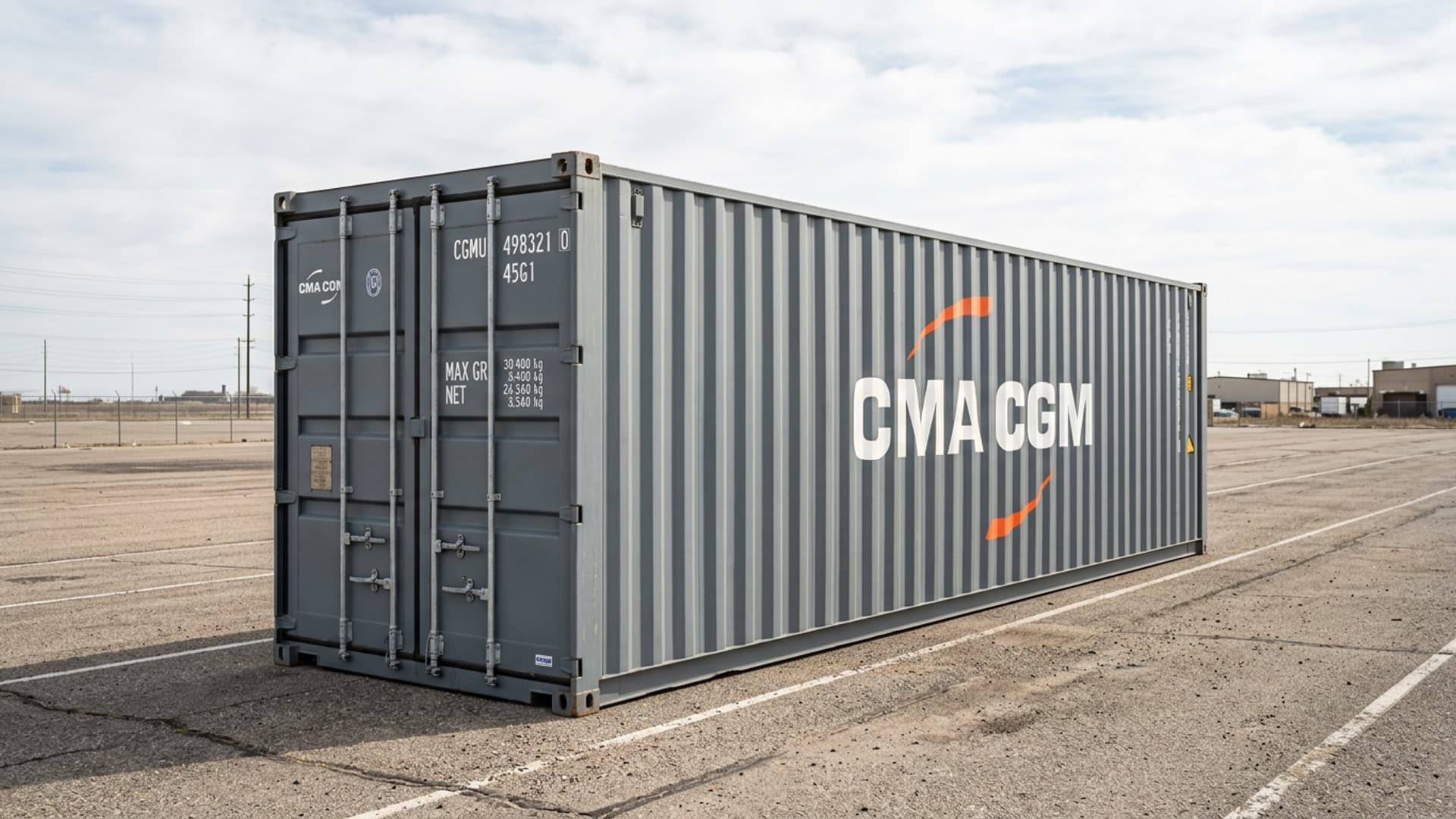
The volume format for a 40-foot shipping container
The 40-foot is the default choice when storage capacity exceeds 30 m³, and essential for habitable conversions (in its high cube version with an interior height of 2.69 m). Here are exact dimensions, prices in 2026, and comparison to two 20-foot containers.
Key Features
- External length
- 12,192 m
- External width
- 2,438 m
- External height
- 2,591 m
- Internal Height
- 2,390 m
Dimensions and capacities
| Characteristic | Standard dry | High cube |
|---|---|---|
| External length | 12,192 m | 12,192 m |
| External width | 2,438 m | 2,438 m |
| External height | 2,591 m | 2,896 m |
| Internal Height | 2,390 m | 2,697 m |
| Internal floor area | 28,3 m² | 28,3 m² |
| Internal volume | 67 m³ | 76 m³ |
| Tare weight | 3 600 – 3 800 kg | 3 800 – 4 000 kg |
| Maximum gross weight | 30 480 kg | 30 480 kg |
| Payload capacity | ~26 680 kg | ~26 480 kg |
Price 2026
| Status | 40 feet standard | 40 ft high cube |
|---|---|---|
| Brand new | £4,410 – £5,775 | £4,725 – £6,510 |
| One-trip | £4,095 – £5,040 | £4,410 – £5,670 |
| Grade A used | £3,045 – £3,990 | £3,360 – £4,410 |
| Grade B used | £2,415 – £3,360 | £2,730 – £3,675 |
| Grade C used | £1,995 – £2,835 | £2,205 – £3,045 |
Delivery to add: £368 – £1,050 depending on the zone. A 40 feet is longer to handle than a 20 feet — plan for a minimum access of 22 m and 4,5 m clearance height.
Available RAL colours
Frequently Asked Questions
What are the dimensions of a 40 feet?+
External (standard dry): 12,192 × 2,438 × 2,591 m. Internal: 12,032 × 2,352 × 2,390 m. Internal floor area: 28,3 m². Internal volume: 67 m³. The high cube version gains 30 cm in height (2,896 m external, 2,697 m internal) for a volume of 76 m³ — this is the preferred variant for converted living or office space.
How much does a 40 feet cost in 2026?+
Standard dry: £4,410 – £5,775 new, £3,045 – £3,990 Grade A used. High cube: £4,725 – £6,510 new, £3,360 – £4,410 Grade A used. Excluding delivery (£368 – £1,050 depending on zone — a 40 feet is heavier and more cumbersome to handle than a 20 feet).
40 feet standard or high cube: how to choose?+
Simple rule. For pure storage, transport, workshop: the standard is sufficient (savings of £300 to £700 compared to high cube). For any habitable conversion, office, commercial space, site cabin: the high cube is almost mandatory, the extra 30 cm in height make the difference between a comfortable space and one that hurts your back after two years.
How many Euro pallets fit in a 40 feet container?+
22 Euro pallets (1.20 × 0.80 m) on the floor, 44 if stackable on two levels. 20 industrial pallets (1.20 × 1.00 m) on the floor, 40 on two levels. That’s almost double a 20 feet container — recommend a 40 feet for at least 20 pallets to transport or store.
Can a 40 feet container be delivered in an urban area?+
More complicated than a 20 feet. The truck chassis (tractor + trailer) measures 18 to 20 m long. Access must allow this length plus a lateral unloading zone of 4 m. In central Paris or Lyon, expect systematic additional costs (£200 to £500) for off-peak delivery, city hall authorisation, or crane handling from an accessible point.
Two 20 feet containers or one 40 feet?+
Common question. In terms of price, two 20 feet containers cost about 20 to 30% more than a single 40 feet container. Advantages of two 20 feet: modularity (separate placement, independently movable), possibility to sell or rent one later. Advantages of one 40 feet: lower price per cubic metre, simpler logistics, uninterrupted space of 12 m (useful for long-term storage, workshops with long tools, open conversion).
Also worth seeing
Price of a 40 feet container: 2026 barometer
Detailed purchase + rental grid for the 40 feet dry and high cube containers, 10 variants × conditions.
20-foot container
The all-purpose standard — 33 m³ usable.
High cube detailed
The 30 cm that change everything for conversion.
Used container
Classes A/B/C, points to inspect.
40ft container hire
Temporary need? Compare the monthly rates of a 40ft from £130/month.
45ft container
The size above: 86 m³, the largest standard.
Lever competition
A form, 5 quotes from suppliers of certified 40-foot containers.