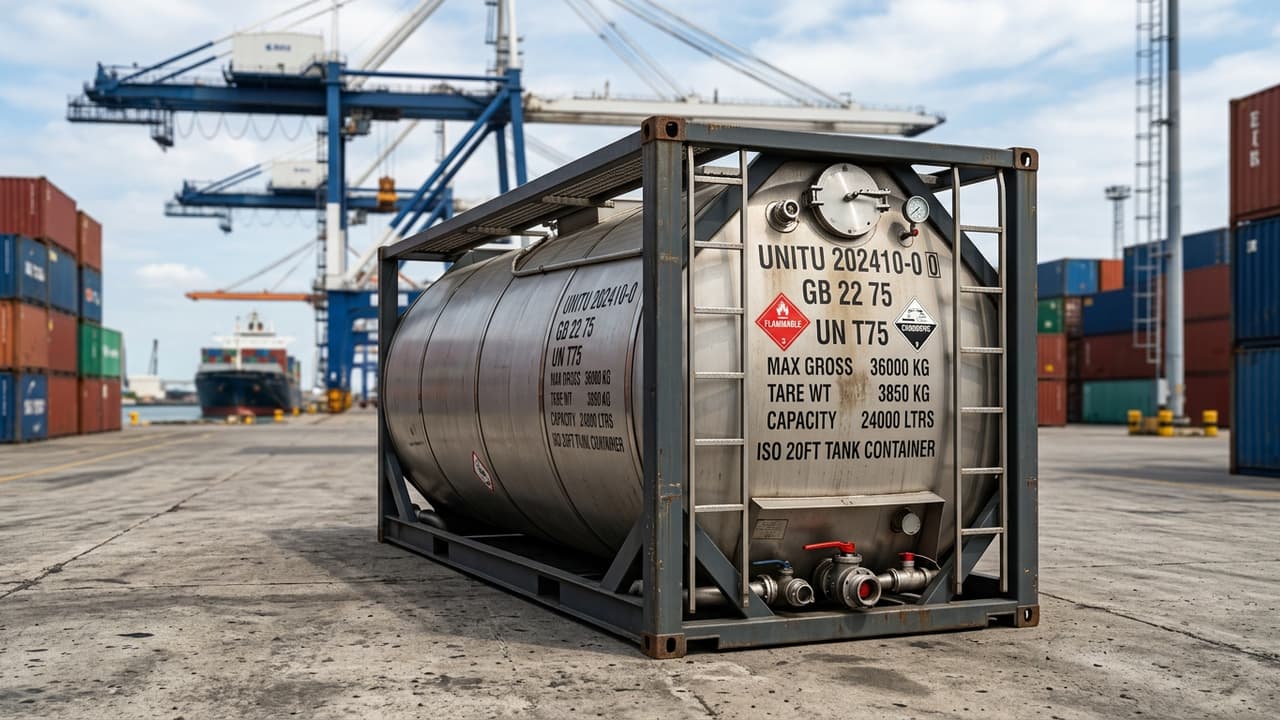
Tank container: the ISO tank for liquids, gases and powders
The tank container is a stainless steel tank integrated into an ISO 20-foot frame. External dimensions identical to those of a standard shipping container, but inside: 24 m³ of tank capacity to transport wines, oils, chemicals or liquefied gas by sea, rail and road — without break bulk.
Key Features
- External length
- 6,058 m
- External width
- 2,438 m
- External height
- 2,591 m
- Usable capacity
- 24,000 to 26,000 litres
Dimensions and capacity
| Characteristic | Tank 20 feet (T11) |
|---|---|
| External length | 6,058 m |
| External width | 2,438 m |
| External height | 2,591 m |
| Usable capacity | 24,000 to 26,000 litres |
| Tare weight | 3.6 to 4.5 t |
| Payload capacity | up to 26 t |
| Tank material | Stainless steel 304 or 316 |
| Service pressure | up to 1.75 bar (T11) |
Standards to know
- T11 — non-hazardous liquids, max pressure 1.75 bar. The most common format: wines, vegetable oils, milk, syrups, non-corrosive resins.
- T14 — corrosive or toxic but non-hazardous liquids, pressure 1.75 to 4 bars. Diluted acids, bases, industrial solvents.
- T22 — dangerous goods classified ADR / IMDG. Reinforced wall thickness, standardised safety equipment.
- T50 — liquefied gases low pressure. LPG, butane, propane. Pressurised tank, mandatory safety valves.
- T75 — cryogenic. Liquid nitrogen, liquid oxygen, liquid argon. Double-walled vacuum insulated, maintains -196 °C in operation.
- Periodic testing — every 2.5 years (intermediate inspection), every 5 years (full test). Without up-to-date certification, the tank is prohibited on roads and at ports.
Variants of the tank container
Frequently Asked Questions
What exactly is a tank container?+
A cylindrical stainless steel tank integrated into an ISO standard 20-foot frame. From the outside, dimensions are strictly those of a shipping container: same corner posts, same reinforcements, same compatibility with ships, trains and truck carriers. Inside, it's a tank ranging from 21 to 26 m³ with loading dome, discharge valve and sometimes heating system.
What is it designed for?+
Intermodal transport and storage of liquids, liquefied gases and fine powders. Three main families. Chemical: acids, bases, solvents, resins (T11 standard for non-hazardous products, T14 for corrosives, T22 for hazardous classified products). Food: wines, vegetable oils, milk, syrups (specific food-grade standards, T11 stainless steel 304 or 316). Energy: fuels, liquefied petroleum gas (LPG), liquid nitrogen (T50 to T75 standards according to pressure).
What are the dimensions and capacities?+
ISO 20-foot frame: 6.058 m × 2.438 m × 2.591 m exterior, identical to a dry container. The tank inside typically holds 24,000 litres (24 m³) for non-pressurised liquids, up to 21,000 litres for corrosive products (thicker walls), 20 to 26 m³ depending on model and standard. Tare weight: 3.6 to 4.5 tonnes. Maximum liquid payload: up to 26 tonnes.
What standards apply to which product?+
T11: non-hazardous liquids, max pressure 1.75 bar — the most common format. T14: corrosive/toxic liquids, pressure 1.75 to 4 bars. T22: hazardous classified products ADR/IMDG. T50: low-pressure liquefied gases (LPG, butane, propane). T75: cryogenic liquefied gases (liquid nitrogen, oxygen, argon). Each standard mandates periodic inspections (every 2.5 years or 5 years) otherwise circulation is prohibited.
What is the cost of a tank container in 2026?+
Grade A used T11 food-grade stainless steel 316: £7,700 to £12,000. Grade A used T14 chemical: £10,000 to £15,500. Grade A used T50 LPG: £15,500 to £24,000. Brand new T11 standard: £18,500 to £27,000. Brand new T75 cryogenic: £47,000 to £76,500. Current rental rate: £210 to £510/month depending on the norm. Niche market, always go through a comparison tool or an intermodal specialist.
Can a tank be converted into something else?+
No, it is the only type of container for which conversion out of liquid/gas use is almost impossible. The tank cannot be removed from the ISO frame (welds, internal crossbeams), and the usable volume inside the tank has no practical interest for dry storage or fitting-out. For these uses, look at a standard dry or an open top instead.
Need a tank container?
5 quotes compared in 48 hours, certified intermodal suppliers, T11 to T75 norms.