Shipping container for humanitarian and NGO use
The shipping container has become the standard for modern humanitarian aid. Rapid deployment, robustness in extreme climates, global maritime logistics, ISO standardisation: what makes global logistics work also drives humanitarian mission logistics. Concrete examples, suppliers, budgets.
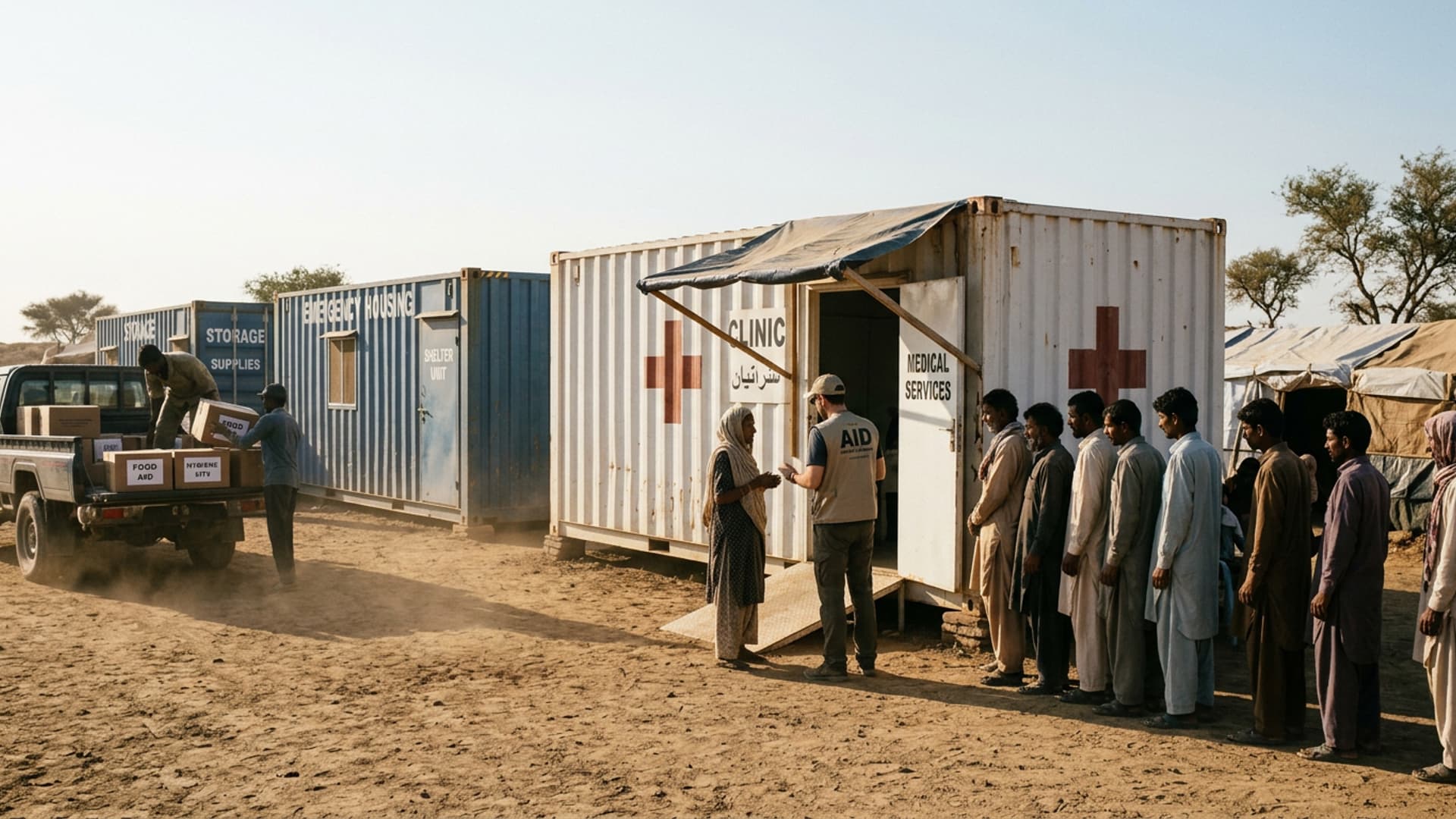
Typical mission configurations
Emergency Accommodation
A 40-foot high cube container converted into a dormitory or living space for mission teams. Insulation, ventilation, sanitary facilities. Resistant to extreme conditions. Demountable for rotation.
Mobile Health Centre
Consultation cabin + cold medical storage + simple laboratory. Critical vaccine cold chain, often with solar-powered reefer.
Mission Logistics
Field warehouse for food supplies, hygiene kits, medicines, tarps, equipment. Secured against intrusion. Often several units grouped on an operational base.
Known deployment examples
- Doctors Without Borders (MSF) — uses standard medicalised shipping containers since the early 2000s, notably for Ebola crises, Covid, and armed conflicts. Own fleet and rentals according to crisis needs.
- French Red Cross / International Red Cross — logistics and accommodation containers deployed in Haiti, Nepal, Turkey, Ukraine. Standardised modules for rapid rotation.
- UN / UNHCR — containers for refugee housing, mobile schools, distribution centres. Massive use in long-term camps.
- local NGOs and associations — more modest solutions: 1-3 shipping containers for a mobile school, training centre or dispensary in underserved areas.
- crisis event missions — in natural disasters (storms, floods), shipping containers can be deployed on site for temporary shelters within 72-96 hours from European stockpiles.
Frequently Asked Questions — Humanitarian Sector
Why has the shipping container become the humanitarian standard?+
Three advantages. (1) Logistics: it can be shipped by sea cargo anywhere, it can be assembled on site without a crane, and it withstands rough handling. (2) Durability: Corten steel resists extreme climates (desert, tropical humidity, polar cold). (3) ISO standardisation: once in place, any module is interchangeable with another. MSF, Red Cross, UN agencies have used them extensively for 15 years.
What concrete uses in a humanitarian mission?+
Emergency accommodation for teams (living, sleeping, hygiene), mobile health centre (consultation, medical storage with cold chain), logistics warehouse (food, hygiene kits), community kitchen, administrative office for the mission, radio/telecom room, education module (mobile school), technical workshop for equipment repair.
How does the vaccine cold chain work in areas without electricity?+
Two options. (1) Reefer + diesel generator (150-300 kVA for several modules) — classic, robust, fuel easy to replenish. (2) Autonomous solar reefer: panels + batteries + low-consumption reefer. More expensive (additional £15,750 – £42,000), but autonomous if fuel resupply is impossible. Choice depends on mission duration and isolation.
Can one purchase a container specifically transformed for humanitarian use?+
Yes, specialised manufacturers produce turnkey containers for missions: equipped medical cabin, mobile operating block, container school, mobile maternity unit. Unit cost £42,000 – £210,000 varies by equipment. Some large NGOs (MSF, Red Cross) have their own rolling stock. For smaller organisations, rental + onboard equipment is more flexible.
What lead times for sending a humanitarian shipping container?+
On French soil: 72 h (optional equipment not included). For international maritime shipment from European port: 2-8 weeks depending on destination (Mediterranean: 1-2 weeks, West Africa: 3-5 weeks, Asia: 4-6 weeks). By air cargo (container dismantled or light module): 1-3 days, but cost is 5-10× higher. For absolute emergency, air transport is mandatory — otherwise maritime for volume.
Humanitarian mission: rapid deployment
5 experienced suppliers in demanding field conditions.