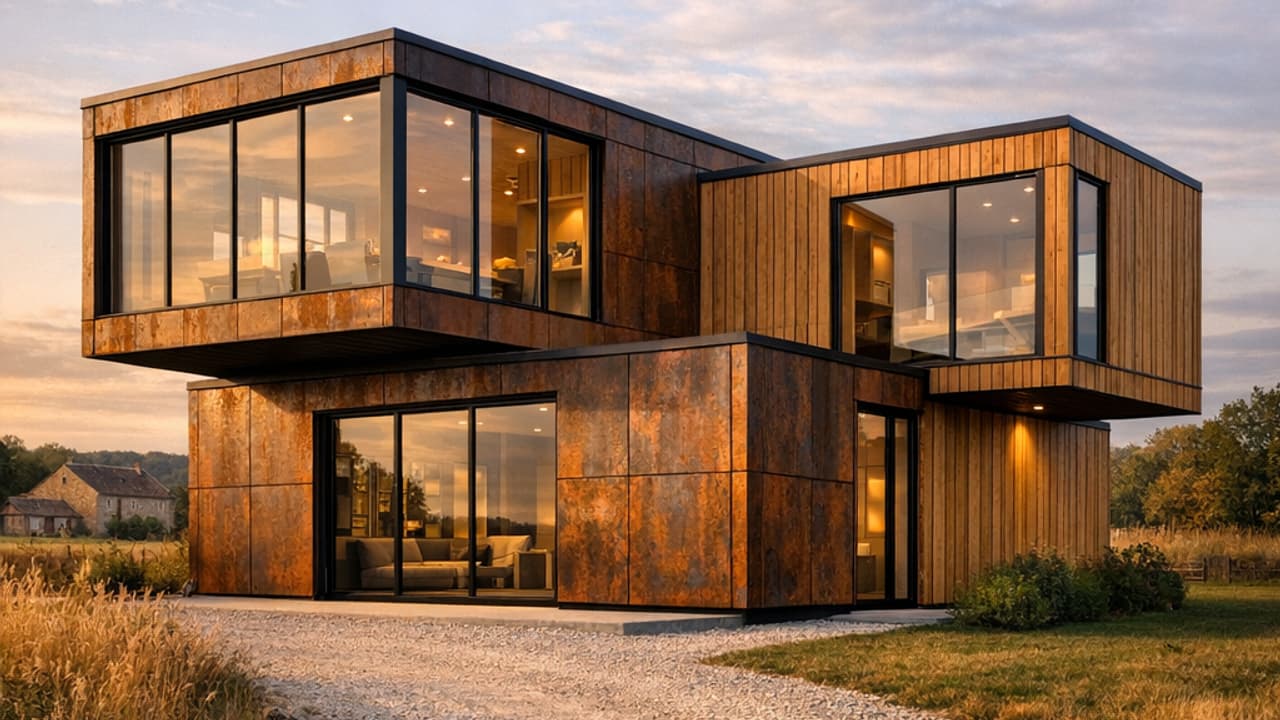
Container home: prices, plans and steps to build in 2026
More than 3,000 container homes are built each year in France — from a T3 of 70 m² for a young couple to a family villa of 150 m² in rural areas. This pillar guide covers everything: typical plans, real prices by finish level, the seven steps of a project, Building Regulations Part L compliance, bank financing, resale value.
Price 2026 detailed by finish level
Three levels of finish dominate the market. The choice heavily impacts the price per square metre — and the buyer's future perception at resale.
| Item | Basic Finish | Standard Finish | Premium Finish |
|---|---|---|---|
| Price per m² turnkey | £1,155 – £1,470 | £1,470 – £1,890 | £1,890 – £2,625 |
| Insulation | 80 mm sprayed polyurethane (minimum Building Regulations Part L) | 100 mm PU + wood wool insulation 40 mm interior | 120 mm PU + expanded cork 60 mm + wooden cladding |
| Glazing | Standard double glazing | High-performance double glazing | Triple glazing + motorised roller shutters |
| Heating | Electric convectors + reversible air conditioning | Air-to-air heat pump | Air/water heat pump + underfloor heating + thermal solar panels |
| Ventilation | Single-flow HRV (Hygroregulating) | Dual-flow VHR | Dual-flow VHR + Heat Recovery + CO2 Control |
| Floor Coverings | Laminate + Ceramic Tiles for Wet Areas | Engineered Wood Flooring + Large Format Porcelain Tiles | Solid Wood Flooring + Large Format Porcelain Tiles + Stone |
| Kitchen | IKEA Kit or Equivalent, £3,000-£5,000 | Mid-range Custom Kitchen, £8,000-£15,000 | Interior Designer Kitchen, £20,000-£40,000 |
| Home Automation | Basic (connected thermostat) | Home Assistant + lighting/curtain scenarios | Complete KNX + voice control + integrated security |
| For a T4 of 90 m² | £105,000 – £131,250 | £131,250 – £173,250 | £173,250 – £236,250 |
Turnkey price excluding land costs, specific infrastructure (if the site is not already serviced: +8 000-£21,500), urban planning taxes, and exterior landscaping (terrace, garden, pool). Savings compared to a brick-built equivalent house: 15-35 % depending on finish level.
Why container homes are gaining ground
A marginal phenomenon ten years ago (a few dozen projects per year in France), the container home has become a credible and costed alternative. Five factors explain this rise.
1. Rise in brick-and-mortar costs (2020-2026)
+28% on individual house construction costs over five years according to FFB (construction federation). The container offers an alternative with more stable costs, linked to the price of steel and maritime transport.
2. Short construction period
6-12 months for a container home vs 18-24 months for a traditional brick-and-mortar house. The factory produces modules in parallel with site foundations, a decisive time-saving measure in a tight labour market.
3. Building Regulations Part L performance achievable
Steel structure with a high-performance insulation envelope. Result: well-designed container homes easily meet Building Regulations Part L thresholds and some even achieve BEPOS (positive energy building) status with solar panels.
4. Contemporary Aesthetic Valued
Container architecture has moved from 'oddity' to 'assumed choice' in design press and on social media. Instagram and Pinterest are full of completed projects that inspire future buyers — demand driven by the 30-45 age group.
5. Modularity and Scalability
Adding a module in five years to create an extra room? Possible with a container, almost impossible with a brick-built house. Scalability appeals to families anticipating growth (children growing up, remote working, accommodating elderly parents).
6. Declared Low-Carbon Approach
Reusing a second-hand container avoids new production. Life-cycle analysis by ADEME shows that the carbon footprint of a well-designed container home is 30-50% lower than an equivalent brick-built house (ADEME life cycle assessment). Strong CSR argument for committed buyers.
Standard Plans: From T3 to Family Villa
All container homes start with multiples of 40-foot HC containers (≈ 28 m² gross, 24 m² net after insulation). Here are the standard configurations observed among specialised builders.
T3 — Two modules assembled (60-75 m²)
Config: 2 × 40-foot HC side by side, removable partition between them to create an open space. Living room + open kitchen 30 m², two bedrooms 10-12 m² each, bathroom 5 m², separate WC. For: young couple, buy-to-let investment, second home. Turnkey budget: £94,500 – £147,000 excluding land.
T4 — 3 to 4 modules (85-110 m²)
Config: 3 modules in an L-shape or 4 modules in a U around a central terrace. Living room-kitchen 35-40 m², 3 bedrooms including one master suite, 2 bathrooms, laundry room. Option for a light mezzanine to gain volume. For: family with 1-2 children, main residence. Turnkey budget: £136,500 – £204,750 excluding land.
T5 / Villa — 5 to 6 modules (130-160 m²)
Config: 5-6 modules, often on two levels, with a central circulation area. Cathedral living room double height 50 m², 4 bedrooms, 2-3 bathrooms, office, separate container garage. Architect required for projects over 150 m². For: large families, dream projects, property investment. Turnkey budget: £210,000 – £336,000 excluding land costs.
Container extension to existing house
Config: 1 module attached to the existing house for a master suite, home office or independent teenager bedroom. Connection to existing utilities, wooden cladding or render for aesthetic consistency. For: owners who want to increase living space without moving. Turnkey budget: £31,500 – £63,000 for 25-30 m².
The 7 steps of a container home project
From initial decision-making to key handover, expect 6 to 12 months based on the complexity of the project. Here is the typical reverse planning observed with French specialists in this field.
Step 1 — Preliminary studies and pre-project
Planning certificate at town hall (free CU), PLU check, G2 ground study (£1,500-£3,000), choice of builder, preliminary architectural project (APS then APD), master plan. This is the phase where everything happens — rigour at this stage = smooth construction site afterwards.
Step 2 — Submission of building permit application
Complete PC file (Cerfa 13406) with architect’s plans, Building Regulations Part L notice, landscape integration, thermal performance certificate. Submit in town hall. Processing time is two months for a single-family home, three months if in ABF or protected area. Third-party appeal possible two months after site signposting.
Step 3 — Financing and foundation start
Final loan approval (4-8 weeks processing), funds release. Simultaneously: earthworks and utilities installation (water, electricity, fibre, sewage), pouring of foundations according to ground study (concrete piles or longrines, sometimes raft).
Step 4 — Module assembly in workshop
While laying the foundations, containers are converted into a workshop: window and door cutouts, full project insulation sprayed on, electrical and plumbing installation, interior partitions, floor and wall finishes, partially equipped kitchen and bathrooms. Duration is 6-10 weeks.
Step 5 — Transport and site placement
Exceptional convoy: 1-2 modules per semi-trailer. Installation by mobile crane (£750-1,500/day × 1-3 days depending on number of modules). Structural assembly on site, welding connections, waterproofing joints. Spectacular moment for owners (construction site becomes home in 24-72 hours).
Step 6 — Finishing and Connections
External cladding (if desired), final connections to networks, roof installation if contemporary style, terrace and light exterior amenities, appliance installation, start-up of heat pump/ventilation system. Longest phase after workshop.
Step 7 — Inspections, Acceptance and DAACT
Blower door test (air tightness) for Building Regulations Part L certification, Consuel electrical certificate, site acceptance with builder (acceptance certificate, list of reservations), declaration of completion of works in town hall, establishment of building damage insurance. Move-in possible.
Building Regulations Part L: insulation, heating, performance
Since January 2022, all new individual house construction must comply with the Environmental Regulation 2020. For a container home, meeting these thresholds is perfectly feasible — but requires an uncompromising thermal envelope.
Building Regulations Part L Thresholds to Meet
- Bioclimatic Need (Bbio): varies by climatic zone (H1, H2, H3), target -20% vs RT2012.
- Primary Energy Consumption (PEC): < 100 kWh/m²/yr (highly variable depending on configuration).
- CO2 Emissions (IC construction): progressive phase-out period 2022-2031, increasingly stringent.
- Summer Comfort (DH): degree-hours of discomfort < threshold ceiling according to zone.
Technical Container Solutions
- Sprayed polyurethane insulation 100-120 mm on all six faces (roof, floor, four walls), mandatory on the exterior side to avoid thermal bridges.
- Air tightness < 0.6 m³/h/m² at blower door test — Building Regulations Part L requirement, mandatory upon delivery.
- Mechanical Ventilation with Heat Recovery (MVHR) with heat recovery ≥ 85 %, F7 filters minimum, almost mandatory.
- Triple glazing or high-performance double glazing (Uw ≤ 1.1 W/m²·K), with roller shutters for summer comfort.
- Air-to-air or air-to-water heat pump as main system, COP ≥ 3.5, often complemented by a wood pellet stove for aesthetic appeal.
Insulation budget Building Regulations Part L complete for a T4 of 90 m²: £21,000 – £36,750 (depending on material brands and regional labour costs). This item represents 15-20 % of the total budget, but it is non-negotiable for compliance and long-term performance.
Foundations, networks and sanitation
The technical base under your shipping container home undergoes a soil study (G2 mandatory since 2020 in clay areas), followed by an adapted choice based on the nature of the terrain and your future mobility aspirations.
| Foundation Type | Usage case | Cost (T4 of 90 m²) | Demountability |
|---|---|---|---|
| Spot concrete pads | Stable ground, light building, future mobility desired | £2,100 – £4,725 | Yes (demountable) |
| Peripheral concrete strip foundations | Balance stability / cost, majority of projects | £4,725 – £9,450 | Partial |
| Complete concrete slab | Permanent residence, unstable ground, flood zone | £8,400 – £18,900 | No |
| General contractor | Clay soil, G2 studies unfavourable | £15,750 – £31,500 | No |
| Screw piles / micro-piles | Very loose soil, slope, karstic zone | £12,600 – £26,250 | Yes (specialists) |
Networks and infrastructure
If your land is not serviced: add £6,800 to £21,500 for bringing the four networks (drinking water, electricity from Enedis, collective or individual sanitation, fibre optic). Collective sanitation is simpler (connection to communal sewer system £2,600-£5,100). Individual sanitation (septic tank + spreading or micro-station) costs £5,100-£13,000 and requires a dedicated soil study SPANC.
Bank financing: which banks lend?
Contrary to a common belief, banks do lend for container home projects — with a slightly more demanding file than usual. Here is the landscape in France for 2026.
Mortgage lenders open to container builds
Self-build mortgage providers (Buildstore, BuildLoan brokers), Ecology Building Society and some regional building societies have funded container conversions. High-street lenders (Barclays, Halifax, Nationwide) are cautious — they typically require: full planning permission granted, fixed-price contract with an NHBC or LABC-warranted builder, structural engineer sign-off, EPC band C or better, and a recognised warranty (Premier Guarantee, BuildZone, ABC+).
Reserved banks (possible via intermediary)
Santander UK, TSB, Metro Bank: less familiar with such projects, sometimes a local advisor will refuse outright. Often easier through a mortgage broker who knows the right contacts. Quota and rates are identical to standard once approval is granted.
Specialised brokers
Independent mortgage brokers (Habito, Trussle, John Charcol, L&C Mortgages, Mortgage Advice Bureau) work with self-build and alternative-housing lenders. Broker fees typically range from 0.3 % to 1 % of the loan amount or fixed (£500-£1,500). They negotiate rate, term and warranty acceptance with the lender — useful when standard high-street banks decline a container build.
Critical point: the bank's valuation of the property may be 10-15% lower than a comparable traditional home — because the secondary market is less developed. Expect to make a stronger down payment (20-25% instead of 10%) or present recent comparables (sales in your region) to support the actual value of the project.
Resale Value: what does the market say in 2026?
The secondary market for container homes is still young but is beginning to structure itself. The first resale observations made (2020-2025) allow trends to be identified, with marked differences according to region and level of finish.
Average discount observed
15-25% compared to a brick-built house in the same area (ContainerEU analysis of 40+ tracked resales, 2020-2025). Lower (5-15%) for architecturally recognised projects with high-quality photo renderings. Higher (25-35%) in traditional suburban areas where the average buyer is more conservative.
Sales Period
3-6 months on average, comparable to a brick-built house. The real filter is the buyer — a smaller but often motivated and quick-to-decide public (young eco-conscious couples, atypical buyers, Airbnb investors) when they find the right project.
Most Favourable Regions
Most receptive UK markets: South West (Devon, Cornwall — coastal alternative-build culture), Wales (rural plots, lower planning resistance), Scotland (Highlands self-build tradition), South East rural fringes (high land prices push budget-constrained buyers to alternative routes).
Most Difficult Regions
Grand Est, Bourgogne-Franche-Comté, Hauts-de-France: conservative market, buyers demand traditional standards. The discount can exceed 30% if the project is not architecturally exceptional.
Resale Strategy: document the project (plans, construction site photos, Building Regulations Part L certifications, invoices), work on final photos with a real estate photographer (£300-£500), prefer real estate agencies familiar with alternatives. The narrative (values, eco approach, architectural effort) counts as much as square footage.
Frequently Asked Questions
Is a container house really cheaper than a brick-built one?+
Yes, with the margin narrowing as the project becomes more upscale. For basic finishes (assumed minimalist living): -25 to -35% compared to an equivalent brick-built home. For standard finishes (full Building Regulations Part L insulation, equipped kitchen, smart home technology): -15 to -25%. For premium finishes (high-end materials, advanced smart home tech, architect involvement): the gap narrows to -5 to -15%, sometimes equal. The savings mainly come from the main structure (no heavy foundations, pre-made structure) and shorter construction time (4-8 months vs 12-24 months).
How many high cube 40-foot modules are needed for a family home?+
A high cube 40-foot container offers ~28 m² gross (24-25 m² after interior insulation). Simple calculation: habitable surface aimed ÷ 24. For a T3 of 70 m²: 3 modules. T4 of 90 m²: 4 modules. Villa T5 of 130 m²: 5-6 modules, often over two levels. Allow for a margin of 15-20 % for circulation (corridors between modules when assembled in L or U shapes). Architects recommend thinking in 'combinations of two modules' rather than isolated modules — more efficient to optimise open spaces.
Do banks lend for a container home?+
Yes, but the application is stricter than usual. Banks require: building permit issued, detailed quote from an insured contractor, soil study, Building Regulations Part L compliance certificate. Crédit Agricole, Banque Populaire, Caisse d'Épargne, and Crédit Mutuel have been lending for this type of project for several years. LCL, BNP, and Société Générale are more cautious, often via intermediaries. Interest rates and loan-to-value ratios are the same as usual (10-20 % deposit, 20-25-year term). Critical point: the bank's valuation of the property may be 10-15 % lower than a comparable traditional home — expect to make a stronger down payment.
Is an architect mandatory?+
Architect required from 150 m² of floor area (Law on Architectural Creation, 1977). Below this, it is recommended from 60 m² or when assembling three modules — the architect secures structural calculations (span, lifting points for handling), optimises openings (no cuts in load-bearing sheets at corners), and validates the building permit application. Fees are 8-12 % of total construction costs (excluding land). For a T5 villa, an architect is an investment that pays off through avoided errors.
Does a container home really meet Building Regulations Part L standards?+
Yes, with correctly dimensioned insulation. Target Building Regulations Part L: heating demand < 12 kWh/m²/year in zone H1, < 8 in H3. To reach these thresholds with a container, it requires: sprayed polyurethane insulation 100-120 mm on all six sides, perfect air tightness (infiltration test < 0.6 m³/h/m²), mandatory double-flow MVHR ventilation, triple or high-performance double glazing. Budget for Building Regulations Part L insulation of a T4 home of 90 m²: £21,000 – £36,750. Several specialised builders achieve even BEPOS (positive energy building) with solar panels.
How long does it take to build a container home?+
Typical total timeframe: 6 to 12 months from order to move-in. Breakdown: building permit 2-3 months, foundations and site preparation 1-2 months, module assembly in workshop 2-3 months (in parallel), installation on site and finishing touches 1-2 months, inspections and acceptance 2-4 weeks. Vs traditional brick-built home: typically 18-24 months. The advantage of a container home = parallelisation of workshop and construction site work, but beware of extended delays in ABF zones (+2-3 months) or if neighbours appeal (+2 months).
What resale value for a container home after 10-15 years?+
Market still young in France but structuring. The first resales observed (2020-2025) show a discount of 15-25 % compared to an equivalent traditional brick-built home, but resale times comparable (3-6 months). The discount is less pronounced for architect-designed projects, premium villas with contemporary finish, and in areas where alternative housing is valued (PACA, Aquitaine, rural Nouvelle-Aquitaine). Stronger in traditional suburban areas where the market is conservative.
Can an extension be made with a shipping container on an existing house?+
Yes, usage is growing. Limited additional cost compared to a traditional brick extension (-20 to -30%), very short construction period (2-4 months vs 6-12 months), potentially removable. Constraints: connection to existing networks (water, electricity, sewage), aesthetic consistency with the house (often wooden cladding or render for visual blending), mandatory building permit from 20 m² of added surface area. Budget for a 20 m² turnkey extension: £31,500 – £63,000. Very popular for creating a master suite, a home office, an independent teenager bedroom.
Also worth seeing
Your container house project
5 specialised builders for container housing, 5 detailed quotes within 48 hours.