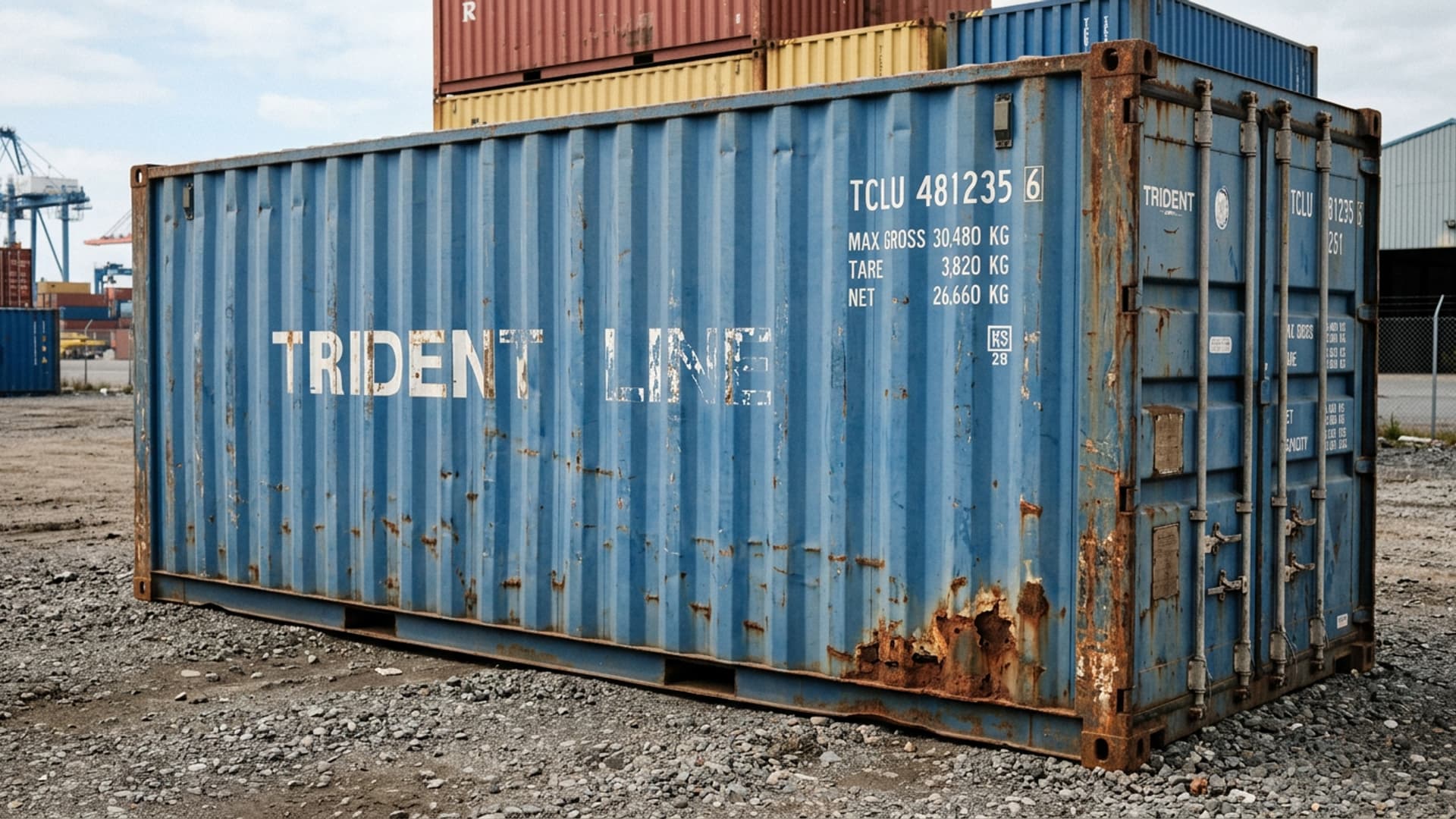
Used Container: Buy Without Getting Ripped Off
A used shipping container costs 30 to 50% less than a new one — for 80% of uses, it's a much smarter investment. Still, you need to understand the Grade A/B/C classes, know what to inspect and recognise a serious supplier from a dubious reseller.
Grade A, B, C explained
For residential, commercial, or display use: Grade A only. For construction site storage or temporary use: Grade B offers excellent value for money. Grade C: reserved for professionals who can inspect on-site and have the expertise.
| Grade | Typical Condition | Price for 20ft | Recommended Use |
|---|---|---|---|
| A | Little branding, sound structure, watertight | 2 200 – 2 800 € | Professional storage, workshop, site cabin, light fitting-out |
| B | Scratches, small dents, sometimes repainted | 1 800 – 2 400 € | Invisible storage, construction site, economical use |
| C | Heavy branding, floor possibly needs repair | 1 400 – 2 000 € | Temporary only, or after serious inspection |
The 7 points to inspect before signing
- Wooden floor. Walk everywhere, press hard. A soft spot = localized rot, replacement cost £400 to £1,200 per module.
- Roof waterproofing. Look at the interior ceiling on sunny days: if you see light spots, the container is leaking. One point = £150 to £400 for solder repair.
- Solder joints at corners. The lower corners take all the load. Cracks = serious structural defect. Avoid unless negotiating a third of the price.
- Doors. They should open by gently lifting the latch, close with a crisp click. If you have to force them, the door is warped — costly repair.
- Door seals. Soft rubber, continuous. If hardened or cracked: waterproofing compromised, replacement £100 to £250 per container.
- Internal smells. Rancidity, chemical residue, mould: indicates previous use. To be negotiated according to your future usage (incompatible with habitation conversion).
- ISO / CSC markings. Valid CSC plate if you want to resell for maritime use. Otherwise, request official deactivation for land use.
Where do used containers come from?
Understanding the economic cycle of a used container helps identify serious offers and avoid false good deals. Most second-hand shipping containers in Europe follow the same path, from shipowners to resale parks.
Step 1 — Fleet Exit by Shipowner (10-15 years)
Maersk, CMA CGM, MSC, Hapag-Lloyd, Evergreen collectively own over 40 million TEU containers. After 10-15 years of intense maritime use, logistics profitability decreases (more downtime for inspections, higher insurance premiums). Shipowners 'remove from fleet' in batches of several thousand units each quarter and resell to specialised wholesalers.
Step 2 — International Wholesaler
A few dozen global wholesalers (Trident, SeaBox, ContainerHQ, ConGlobal) buy in lots of 500-5,000 units from shipowners. They redistribute them to regional depots according to local market demand. It is at this stage that classification A/B/C (visual + basic inspection) takes place. The best containers go first to the most profitable markets.
Step 3 — National / Regional Distributor
Wholesalers resell to professional distributors (those found on ContainerEU). Physical depot, stock of 50-500 units, technicians for minor repairs (painting, doors, seals), direct delivery to end customer. This is the healthiest link for a single unit purchase. Typical margin 15-30% over wholesale price.
Step 4 — Intermediate Reseller (to avoid)
Intermediaries without physical stock, often via online ads or marketplaces. They take orders, source from a distributor or another intermediary, and mark up by 20-40 %. Risks: random stock, uncontrolled quality, no warranty, uncertain lead times. Avoidable if you can contact a distributor with a depot directly.
Where to buy: 4 channels compared
Depending on your profile, budget and risk tolerance, 4 main channels. Each has its advantages and pitfalls.
| Channel | Typical price | Quality | Warranty | For whom? |
|---|---|---|---|---|
| Professional distributor with depot | Reference price | Controlled, graded | 3-12 months watertightness | 95 % of buyers |
| Professional marketplace (ContainerEU, etc.) | Comparison up to -10 % | Same (network of professional suppliers) | Depends on supplier | Informed buyer |
| Private listing (Leboncoin, etc.) | -15 to -30 % | Random, inspect before purchase | None | Professional who knows how to inspect |
| Shipowner / customs auction | -20 to -40 % | Very variable | None | Volume of 10+ units |
Recommendation: for a single unit purchase with peace of mind, go through a professional distributor or marketplace (price comparison + verified suppliers). Private ads can be good deals but require real on-site inspection skills — not for beginners. Auctions are reserved for volume buyers.
Frequently Asked Questions
What exactly is a used container?+
A container 'out of fleet' after 10 to 15 years of intense maritime use. Shipping lines (Maersk, CMA-CGM, MSC, etc.) resell them when their logistical profitability decreases, but they still have a lifespan of 15 to 25 years if used on land. Well-purchased, a used container costs 30 to 50% less than new for near-equivalent use in storage or light conversion.
What are the differences between classes A, B and C?+
Empirical classification (not officially standardised but used by all serious suppliers). Class A: less than 3 years out of fleet, few marks, healthy structure, watertight. Class B: 3 to 8 years since removal, scratches, small dents, sometimes repainted. Always watertight and structurally sound. Class C: more than 8 years old, strong marks, floor may need repair, watertight seams may require redoing. Reserved for temporary uses.
How much does a used container cost in 2026?+
20 feet: Grade A £2,310 – £2,940, Grade B £1,890 – £2,520, Grade C £1,470 – £2,100. 40 feet standard: Grade A £3,045 – £3,990, Grade B £2,415 – £3,360, Grade C £1,995 – £2,835. 40 feet high cube: Grade A £3,360 – £4,410, Grade B £2,730 – £3,675, Grade C £2,205 – £3,045. Delivery to be added (£263 – £1,050).
How can I avoid being scammed?+
Three rules. One: see the container before purchase (or ask for recent dated photos from all angles, inside and out). Two: prefer a supplier with an identified physical depot (avoid 'intermediaries' who do not have their own stock). Three: insist on a return clause if the delivered container does not match what was sold — serious suppliers accept this without difficulty.
What points should I inspect before signing?+
Interior: floor (no soft spots, no suspicious odours, no suspicious stains), waterproofing (no water marks, no internal rust), door seals. Exterior: overall paint condition, welds (no cracks at the corners), roof (no hollow areas where water can pool). Functional: both doors should open and close without effort, all four locks should click sharply.
Can I reclaim VAT on a used container purchased for professional use?+
Yes, if the supplier is subject to VAT (this applies to 99% of professional suppliers) and you are yourself subject to it. The VAT on a container is 20%. The purchase can be amortised over 10 to 15 years depending on usage. Some suppliers also offer leasing (hire with option to buy), allowing the investment to be spread out.
Can I buy directly from Maersk or CMA-CGM?+
In theory, yes — shipping lines sell their containers removed from service via dedicated channels (Maersk Container Industry, CMA CGM Containers). In practice, this is reserved for large volumes (orders of 10+ units) and with unpredictable allocation times. For 1-3 containers, going through a specialised distributor who sources from them is faster, more flexible, and often cheaper. The distributor's margins are offset by the volume negotiation they conduct.
Is a used container covered by a warranty?+
This depends on the supplier. Professional distributor with physical depot: standard commercial warranty of 3-12 months on waterproofing and structure (not accessories). Online reseller without stock: often no warranty, sale 'as is'. Individual or auction: absolute 'as is' sale, no recourse. Our advice: insist on a minimum six-month written warranty on waterproofing, signed, with the supplier's physical address — this is the bare minimum for an investment of £2,000-4,000.
Also worth seeing
Used 20-foot shipping container: Grade A, B, C — prices for 2026
Used 20-foot shipping container: Grade A (excellent condition) from €2,200, Grade B from €1,800, Grade C from €1,400. Receive 5 free quotes within 48 hours.
Used 40 feet container: standard and high cube — prices 2026
Used 40 feet container in standard or high cube: €1,900 to €3,800 depending on grade and height. Water-tight guarantee, delivery within 48 hours.
Used high cube container: 2.69 m interior height, classes A/B/C — price £2026
Used high cube containers 40' and 45': 2.69 m interior height, class A from £3,200, class B from £2,600, class C from £2,100. Quote within 48 hours.
Used refrigerated container: reefer 20', 40' Grade A — price 2026
Grade A used refrigerated container (reefer): 20 feet from €5,500, 40 feet from €8,000. Refrigeration unit tested, brands Carrier, Thermo King, Daikin.
Used open top container: classes A/B roof, price £2026
Used open top 20' and 40': PVC coated tarpaulin roof, Grade A from £2,800, Grade B from £2,200. Ideal for crane loading, machines, high goods.
Used flat rack container: platform with collapsible panels, price £2026
Used flat rack 20' and 40': fixed or collapsible (collapsible) walls, €3,200 to €8,000. Payload 30-45 t. Ideal for oversized construction industry loads.
Used tank container: ISO 6870 bulk liquid tanker
Used tank container ISO 6870: £9,000 to £35,000 depending on volume (24-26 m³) and material (inox 316L, epoxy). Suitable for wine, chemicals, food.
Brand new container
When to pay for brand new? Warranty, finishes.
One-trip
The ideal compromise between brand new and used.
Guide: new vs used
10-year TCO calculation, recommendations by use case, detailed table.
Compare 5 suppliers of used containers
Price difference observed up to 35% for the same need.