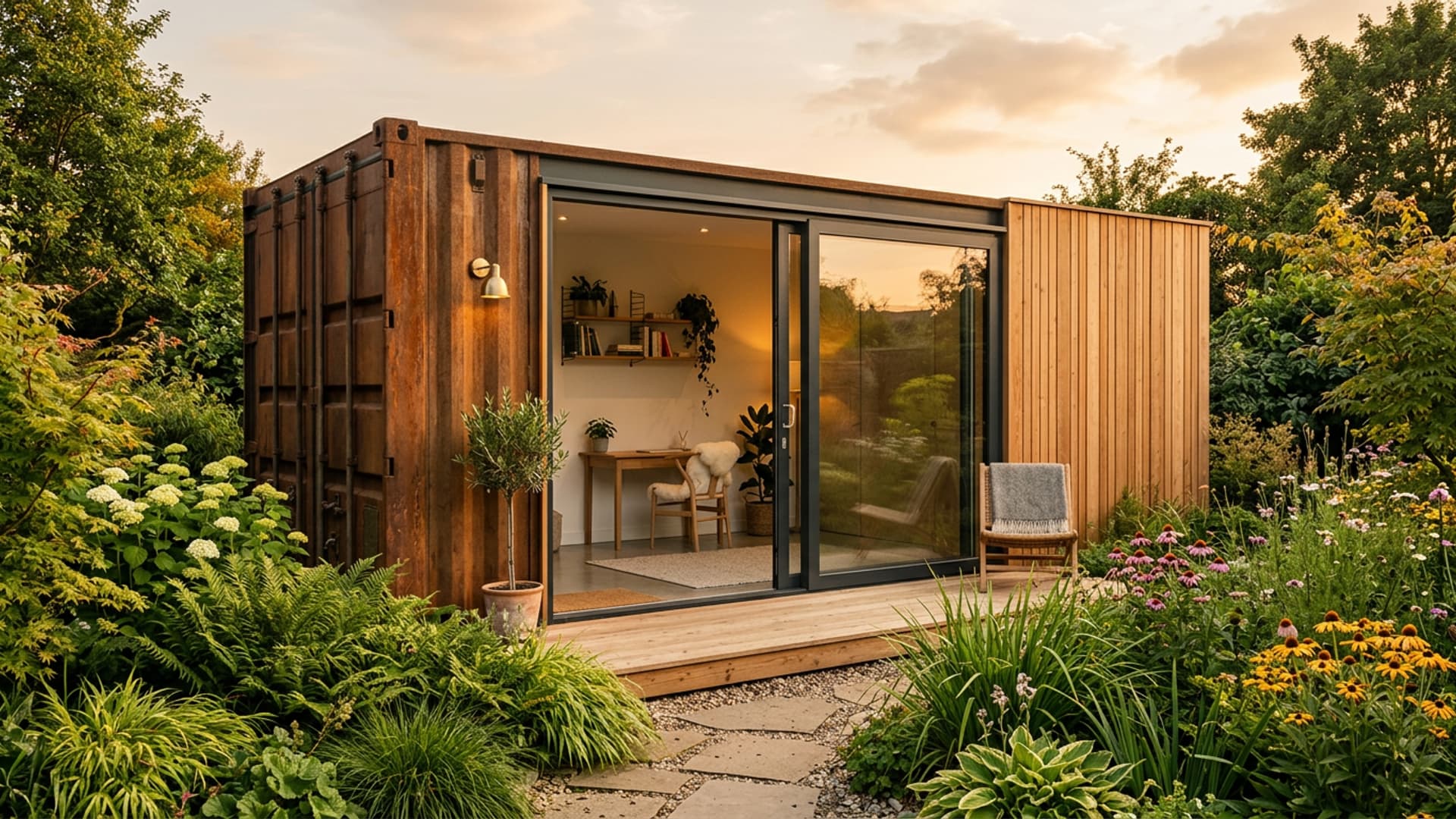
Converted container : tiny house, pool, office, retail space
Transforming a shipping container into living, working or sales space has become a real alternative to traditional construction — faster, cheaper, more original. However, it is essential to follow the right steps: urban planning permits, structure, insulation, finishes. This guide tells you everything, with figures included.
What does it really cost?
The price of a converted container breaks down into four components: the container itself, transformation (cutting, reinforcement, insulation), networks (electricity, water, drainage), and finishes. Here are the observed ranges on the UK market for the most common uses:
| Usage | Base (20' or 40') | Total delivered budget | Average lead time |
|---|---|---|---|
| Office / professional studio | 20' HC | £12,600 – £36,750 | 4 – 8 weeks |
| Tiny house (1 module) | 40' HC | £29,400 – £57,750 | 8 – 14 weeks |
| Family home (2-3 modules) | 2-3 × 40' HC | £78,750 – £189,000 | 12 – 20 weeks |
| Swimming pool container | 20' or 40' | £18,900 – £47,250 | 6 – 10 weeks |
| Retail / pop-up | 20' or 40' | £15,750 – £57,750 | 6 – 12 weeks |
| Snack / catering | 20' HC | £26,250 – £73,500 | 8 – 14 weeks |
| Workshop / garage | 20' or 40' | £8,400 – £26,250 | 3 – 6 weeks |
Ranges observed in Q1 2026, delivered ready to use, excluding land costs, specific foundations, development charges and architect fees if applicable. Budgets exclude connections (typical £1,575 – £4,725).
Why a converted container?
Three reasons come up in 90% of the requests we receive. First, cost: at equivalent surface area, a converted container costs 15 to 25% less than traditional construction, mainly due to time savings on site. Next, speed: 3 to 5 months of work compared to 9 to 14 months for a brick-built house. Finally, modularity: a shipping container project is designed in stackable and extendable modules, even removable if the use changes.
It's not a miracle technique either. It requires real specialised expertise (not all metalworkers are trained in containers, not all general contractors know how to handle structural peculiarities), vigilance on insulation (thermal bridge is the number one defect), and an administrative authorisation process sometimes longer than initially thought.
Most common uses
Container house / tiny house
From a garden shed of 20 feet to a family home of 2 to 4 modules. Reinforced insulation, aluminium or wood windows and doors, integrated kitchen and bathroom. Budget £30,000 to £180,000 depending on surface area and finishes.
Swimming pool container
Conversion of a 20 or 40 foot container into a watertight swimming pool (liner, concrete, polyester). Faster and cheaper than a traditional shell pool. Budget £16,500 to £39,800 installed, depending on length.
Professional Office / Studio
Garden office, architect studio, coworking space, modifiable open plan area. Ideal for freelancers and small businesses. From £10,800 to £29,700 fitted-out and delivered.
Retail / Pop-up Store
Temporary boutique, brand pop-up store, beach kiosk, event showcase. Mobile, identity-driven, quick to install. £13,500 to £49,500 depending on finishes.
Snack / catering
Fixed food truck, beach snack bar, festival bar, mobile pizzeria. Professional kitchen fit-out (extraction hood, grill, cold room). £23,400 to £63,700 equipped.
Workshop / garage
Artist workshop, motorcycle garage, professional mechanical workshop. Steel structure = anti-vandalism resistance. Optional insulation according to climate. £6,400 to £20,800 fitted.
The 6 steps of a fitted-out shipping container project
Define the project and obtain authorisations
Target surface area, use (residential, commercial, storage), number of modules, location. In parallel: check the PLU, request an urban planning certificate, choose between prior declaration and building permit based on surface area. Allow 1 to 3 months.
Select the base container
Choice between new, one-trip, Grade A used. For residential use: always opt for a high cube (internal height of 2.69 m instead of 2.39 m). Wooden floor to inspect or replace. Avoid classes B and C for high-end conversions.
Structural study and foundations
An empty container weighs 2.2 t (20 feet) to 3.8 t (40 feet) — loaded, up to 30 tonnes. The load points (ISO corners) concentrate the weight. Possible foundations: concrete blocks, longrines, full slab. A geotechnical study is recommended beyond two modules.
Transformation: cutouts, openings, reinforcements
Opening of bays, windows, doors. Each cutout weakens the structure and requires reinforcement (angles, IPN, consoles). Intervention by a metalworker or specialised container company — not a traditional carpenter.
Insulation, plumbing, electricity
Compulsory insulation for any prolonged use in France (mineral wool, cork, sprayed polyurethane — according to Building Regulations Part L constraints if residential). Electrical and plumbing networks exposed or recessed behind lining. Consuel certificate required for electrical installation.
Interior and exterior finishes
Flooring, wall, ceiling coverings. Optional external cladding (wood, composite, metal) for landscape integration. External joinery, equipment (kitchen, bathroom). Allow 4 to 12 weeks depending on the level of finish.
Regulation: do not underestimate it
Contrary to what is sometimes read, installing a fitted-out container is not free. As soon as there is habitable use, commercial use, or surface > 20 m², a building permit is necessary. Some municipalities (especially in coastal areas, classified sites, ABF) impose severe aesthetic requirements. In doubt, the quick and free procedure consists of requesting an operational urbanism certificate (CUb) from your town hall before even buying the land or ordering the container. Allow 1 to 2 months for a response.
The 5 pitfalls to avoid
- Choosing a standard 20 or 40 feet instead of high cube. For housing, the extra 30 cm of height in a high cube (2.69 m interior vs 2.39 m) makes all the difference — once insulation and finishes are applied, you retain comfortable headroom. With a standard container, you end up with just 2.20 m, which can feel claustrophobic.
- Insulate internally without thermal bridging. Corten steel is a massive thermal bridge. Conventional internal insulation allows condensation to pass through — mould and damage are guaranteed within three years. Correct solutions: sprayed polyurethane, or external insulation (more expensive but more effective).
- Multiply cuts without structural reinforcement. An empty shipping container stands upright because its walls bear the load. Each opening must be reinforced with a channel frame or IPN weld. A 'wild' cut can cause the roof to sag under snow.
- Neglect the original floor. The wooden floor of shipping containers is treated with bifenthrin or chlorpyrifos to resist transport humidity. These biocides are incompatible with long-term habitation use. Always replace the floor for housing or commercial use.
- Hand over the construction site to a non-specialised contractor. A shipping container converts differently from a brick-built house. Demand references of previous container projects, visit if possible an already delivered conversion, and do not succumb to the temptation of the cheapest quote from a generalist.
Frequently Asked Questions
How much does it cost to convert a shipping container into a home?+
For a 20-foot converted into a simple studio: £26,250 – £42,000 turnkey (container + full conversion). A 40-foot high cube converted into a T2 apartment: £47,250 – £78,750. A family house of two T3 modules: £84,000 – £147,000. These prices include the conversion but not the land, foundations, connections, taxes and any architect's fees.
Is a shipping container home really cheaper than traditional construction?+
Yes, but not as much as one might think. At equivalent surface area and equipment, a shipping container home costs £1,365 – £2,205/sq m delivered, compared to £1,785 – £2,625/sq m for a conventional brick-built house. The savings are therefore between 15% and 25%. They mainly come from time saved on the construction site (3 to 5 months instead of 9 to 14 months) and a substantial structure that is almost already done (steel frame).
Do you need a building permit for a converted shipping container?+
Yes, starting at 20 sq m of ground coverage, and systematically whenever the use is residential, commercial or public. For a garden office or small workshop < 20 sq m, a prior declaration of works may suffice. In both cases, it's necessary to check the local urban planning regulations — some municipalities impose strict aesthetic requirements (mandatory wooden cladding, prohibition of exposed metal, etc.).
What insulation for a habitable shipping container?+
For permanent housing, Building Regulations Part L requires high thermal performance. Common options: sprayed polyurethane foam (80 to 120 mm, U ≈ 0.20 W/m²K, the most efficient per sq m, £63 – £95/sq m), mineral wool panels (minimum 120 mm, less expensive but less effective), cork or wood fibre (ecological, £84 – £158/sq m). Be careful about thermal bridges at corners and in the roof — this is the typical flaw of amateur conversions.
Does a shipping container pool last over time?+
Yes, provided it's properly waterproofed. Two main options: (1) reinforced PVC liner (same technology as traditional pools, lifespan 12 to 18 years, £16 – £26 per sq m for renovation), (2) polyester resin (more expensive at installation but virtually unalterable over 30 years). The steel of the shipping container is never in direct contact with water — it serves only as a supporting structure. Standard pool water treatment (chlorine, salt, UV) like any other pool.
Can you stack or assemble several shipping containers?+
Yes, this is one of the strengths of the technique. Two modules side by side + opening of the shared wall = a T3 layout. Four modules in an U shape with central patio = a family home. Stacked modules = upper floor. The more complex the project, the more an architect's study is recommended (and it becomes mandatory beyond 150 sq m of floor space).
Can you resell a converted shipping container?+
Yes but the second-hand market is still young. A converted shipping container sells better when it remains functional as a module (dismountable tiny house, transportable studio) than when it's integrated permanently into a building structure (impossible to separate). Resale occurs on Leboncoin, specialised marketplaces, or via our network suppliers who sometimes take back existing conversions.
Should you hire an architect?+
Mandatory from 150 m² of floor area for residential use or for any ERP (public reception establishment) regardless of its size. Strongly recommended as soon as the project exceeds a single module, at least to validate structural cuts. Budget fees: 8 to 12% of construction costs for a full mission.
Also worth seeing
Discuss your container conversion project
Our network includes container transformation specialists throughout the UK. Get 5 quotes to compare.