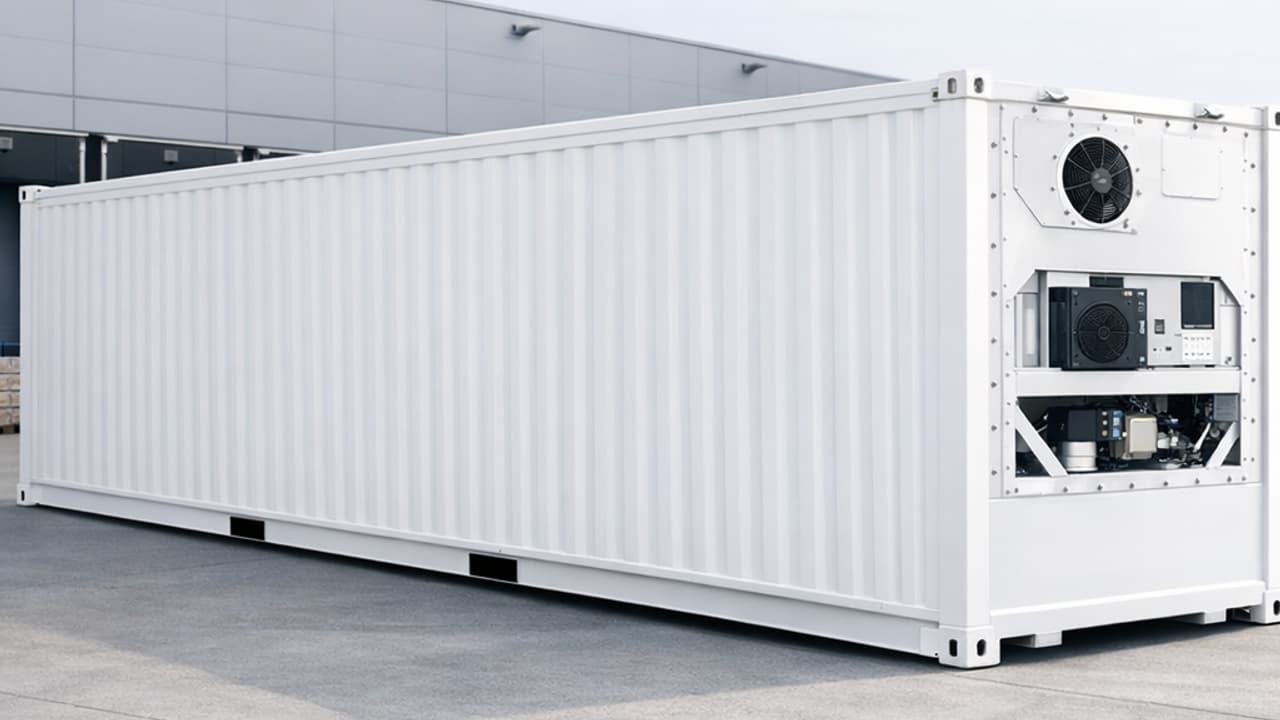
Everything about the reefer container
The reefer is a temperature-controlled container ranging from -25 °C to +25 °C. Essential in agro-food, pharma, event and laboratory industries. Its particularities: higher price, actual electrical consumption, specialised technical maintenance. Here’s the complete breakdown.
Prices 2026: purchase and rental
| Format | New purchase | Grade A used | Long-term rental |
|---|---|---|---|
| 20 ft reefer | £5,690 – £14,700 | £3,682 – £7,875 | £301 – £735/mois |
| 40 ft reefer | £8,033 – £23,100 | £5,355 – £13,650 | £435 – £998/mois |
| 40 feet high cube reefer | £9,371 – £26,250 | £6,359 – £15,750 | £502 – £1,155/mois |
Excluding delivery, excluding connection to a three-phase electrical supply (£315 – £1,575 depending on distance from the distribution board), excluding energy consumed. For events, add rental of a generator set (£84 – £158/day + fuel).
Main uses
- Agro-food industry — buffer storage for fruits/vegetables, beverages, dairy products, frozen goods. Seasonal rental very common (harvests, crops).
- Pharmacy & health — pharmaceutical cold chain: medicines, vaccines, medical devices. Temperature range -25 °C to +8 °C depending on product.
- Events — festivals, trade shows, exhibitions: beverage storage, caterers. Typical duration 3 to 15 days, with generator power possible.
- Laboratory & R&D — biological sample storage, reagents, temperature-controlled testing.
- Industrial backup — temporary supplement to cold rooms during peak activity or breakdowns.
- Marine export — historical use: meat, fruit, fish, vaccines for export.
Temperature ranges and use cases
A modern reefer covers an extremely wide temperature range from -25 °C to +25 °C with accuracy of ±0.5 to ±1 °C depending on the model. The correct setting depends entirely on the product being transported or stored — here is the standard correspondence used in the industry.
| Temperature Range | Typical Use Case | Products |
|---|---|---|
| -25 to -20 °C | Deep Freezing | Meats, fish, frozen ready meals, industrial ice cream |
| -18 to -15 °C | Standard Freezing | Ice creams, frozen vegetables, frozen desserts |
| -5 to 0 °C | Very Cold Refrigeration | Vacuum-packed meats, fresh fish, poultry |
| +2 to +4 °C | Food Refrigeration | Dairy products, cream, yoghurts, caterers |
| +2 to +8 °C | Pharmaceutical cold chain | Vaccines, insulin, temperature-sensitive medications |
| +8 to +14 °C | Chilled controlled | Exotic fruits (banana, avocado), maturing wines |
| +15 to +20 °C | Temperature-controlled | Cosmetics, temperature-sensitive electronics, chocolate |
Dual-temperature (bi-zones): some 40-foot reefers allow two independent temperature ranges within the same module (for example +4 °C and -18 °C), separated by a removable partition. Additional cost ~15-25 % compared to a mono-zone. Relevant for event caterers or pharmaceutical companies with vaccines and temperature-controlled products simultaneously.
Manufacturers, lifespan and maintenance
Assess refrigeration unit, insulation and structure together. Ask for year, maintenance history, PTI report and tests appropriate to project setpoints and conditions. Appearance alone establishes neither performance nor remaining life.
The 4 major brands (90% of the market)
- Carrier Transicold (United States) — global leader, Thinline and Vector ranges for transport, PrimeLINE range for storage. Parts available everywhere, many certified technicians.
- Thermo King (Ireland/Ingersoll Rand) — direct competitor to Carrier, Magnum and CRR ranges. Reputation for reliability, often cheaper maintenance as parts are standardised.
- Daikin (Japan) — LXE and Zestia ranges. Very present in Asia, impeccable quality, but parts sometimes take longer to obtain in Europe.
- Starcool (Maersk/MCI) — premium range, often equipped on intensive maritime reefers. Very durable, specific maintenance required with rare technicians.
Component lifespan
- Compressor : 8-12 years with intensive use, 15+ years with moderate use. Replacement costs £4,200 – £7,350 depending on model.
- Polyurethane panel insulation : 20-25 years before significant degradation (heat loss and overconsumption).
- Corten steel body : Service life and maintenance depend on model, use, exposure and actual condition. Follow manufacturer instructions and obtain a suitable inspection plan and budget; no annual interval or remaining service life applies universally.
- Plan maintenance and inspections : Follow the manufacturer’s plan and actual use. Statutory leak checks depend on refrigerant, charge, equipment type and applicable rules; a general annual service for every reefer is not a universal requirement. Request the schedule, maintenance record and itemised quote.
- Refrigerant fluid : Identify refrigerant and charge from the rating plate. Check restrictions on placing on the market, servicing and recharge for the actual model. Changing refrigerant needs the manufacturer’s technical approval and appropriate competence; no replacement refrigerant is universal.
Check qualifications and certification for the intended work Refrigeration competence and required certificates depend on refrigerant, equipment and type of work. Ask for the applicable technician and, where required, company credentials. An electrical qualification alone does not establish authority to open or recharge the refrigerant circuit. Obtain the scope and price in the quote.
Certifications to verify: CSC, ATP, PTI
These checks have different purposes: CSC concerns container transport safety, ATP concerns covered perishable-food journeys and equipment, and PTI checks refrigeration-unit operation. Determine which applies to the intended use.
CSC Certification (Convention for Safe Containers)
For international transport subject to CSC, check the actual container’s safety plate and examination records. Under the periodic scheme, the first examination is due within five years of manufacture, then at intervals no longer than 30 months; an approved continuous examination programme (ACEP) is an alternative with regular operational checks. Confirm the carrier’s requirements. CSC does not certify food suitability or approve a container building.
ATP: perishable-food transport agreement
ATP concerns the covered perishable foods carried internationally by road or rail between contracting states, including qualifying short sea crossings. It is not triggered merely by moving an empty reefer on a truck or using it for static storage. Check the equipment class, food temperatures, route and national domestic rules. Initial approval can last up to six years; qualifying subsequent checks can extend it by three years. Follow the actual certificate and national procedure: there is no universal ATP annual-inspection requirement.
PTI (Pre-Trip Inspection)
A PTI (Pre-Trip Inspection) is an operational check under the refrigeration-unit manufacturer’s procedure, not CSC or ATP approval. Request a dated report identifying the unit, tests, alarms and results, and a test at your required setpoint before commissioning. Scope, duration and price depend on the model and service provider; there is no universal statutory three-month PTI validity.
Before accepting the equipment: Confirm the documents required for your cargo, journey and static use with the competent authority and carrier. Missing required approval can prevent acceptance for the intended transport. Check insurance coverage and exclusions in the actual policy; a certificate or PTI alone does not guarantee coverage or cargo performance.
Available RAL colours
Frequently Asked Questions
What is a refrigerated container (reefer)?+
A reefer container (refrigerated container) is a shipping container equipped with an autonomous cooling unit that controls the internal temperature. Insulated walls by polyurethane panels 80 to 100 mm thick, adjustable temperature from -25 °C to +25 °C, forced interior ventilation. Typical manufacturers: Carrier Transicold, Thermo King, Daikin.
What is the cost of a refrigerated container in 2026?+
Brand new: £5,690 – £14,700 for a 20-foot, £8,033 – £23,100 for a 40-foot. Grade A used (revised group, less than 10 years): £3,682 – £7,875 for a 20-foot, £5,355 – £13,650 for a 40-foot. The price driver is not the container but the refrigeration unit and its condition. A recently replaced group easily adds +£3,150 – £5,250 to the value.
What is the electrical consumption of a reefer?+
Depends on the target temperature, external temperature, and load. Typical range: 2 to 6 kW in operation (48 to 144 kWh per day). For a -20 °C freezer reefer in summer: expect 5 to 6 kW, roughly £473 – £578 of monthly electricity bill at current business rates. In winter or simple refrigeration 2 to 4 °C: £210 – £368 of monthly bill.
Does a reefer work without electrical connection?+
No, it requires permanent electrical supply. For mobile needs (events, isolated delivery), dedicated generators are available capable of powering a reefer (power range 15 to 25 kVA, rental £84 – £158 per day). Some suppliers offer complete packages « reefer + generator + fuel ». Note: the generator must be sized to support compressor startup (peak power draw).
Should I rent or buy a refrigerated container?+
Refrigerated containers lean more towards rental than dry ones. Reasons: cold group maintenance (£840 – £1,575 per year for serious preventive maintenance), expensive spare parts (compressor replacement: £4,200 – £7,350), need for certified refrigerant technicians. Purchase recommended only if intensive regular use over 5 years or more. Otherwise, rental at £301,219 – £945 per month depending on format.
Can a dry container be converted into a refrigerated one?+
Yes, but it is rarely financially interesting. Additional insulation, cold group, watertight doors, controls: conversion costs £12,600 – £26,250, almost the price of a used reefer. Only relevant case: when you already have the container on site and dismantling/reinstalling a standard reefer would cost more than conversion.
How do I inspect a used refrigerated container before purchase?+
Ask for a dated PTI report or manufacturer-approved operating checks for the offered unit, maintenance history and a test at the required setpoint. Inspect doors, seals, insulation, corrosion and alarms. For international transport subject to CSC, verify the safety plate and current examinations or ACEP; for covered perishable-food carriage, check ATP separately. A recent compressor replacement alone does not guarantee future service life.
Dual-temp: when do we really need two zones?+
Typical cases: event caterer needing +4 °C for cold cuts AND -18 °C for ice cream in the same module. Pharma with vaccines +2/+8 °C and temperature-controlled products +15/+20 °C. Pop-up supermarket with fresh produce section AND frozen foods section. Additional cost at purchase: 15-25 %. Additional rental cost: 10-15 %/month. Do not opt for dual-temp out of 'convenience' — the colder zone dictates overall consumption, hence higher electricity costs.
Also worth seeing
Price of refrigerated container: barometer 2026
Reefer grid for 20' and 40', monthly electrical cost, Carrier vs Thermo King.
Renting a reefer
Monthly rates, use cases pharma/agro/event, electricity included.
Reefer electricity
Have a competent electrician check the connection against the rules in the United Kingdom, the equipment rating plate and the local network operator’s requirements. A French standard or certificate does not automatically apply to this market.
Reefer vs cold room
TCO comparison, mobility, flexibility.
Need a mobile cold chain?
Up to 5 quotes from reefer specialists subject to supplier availability.