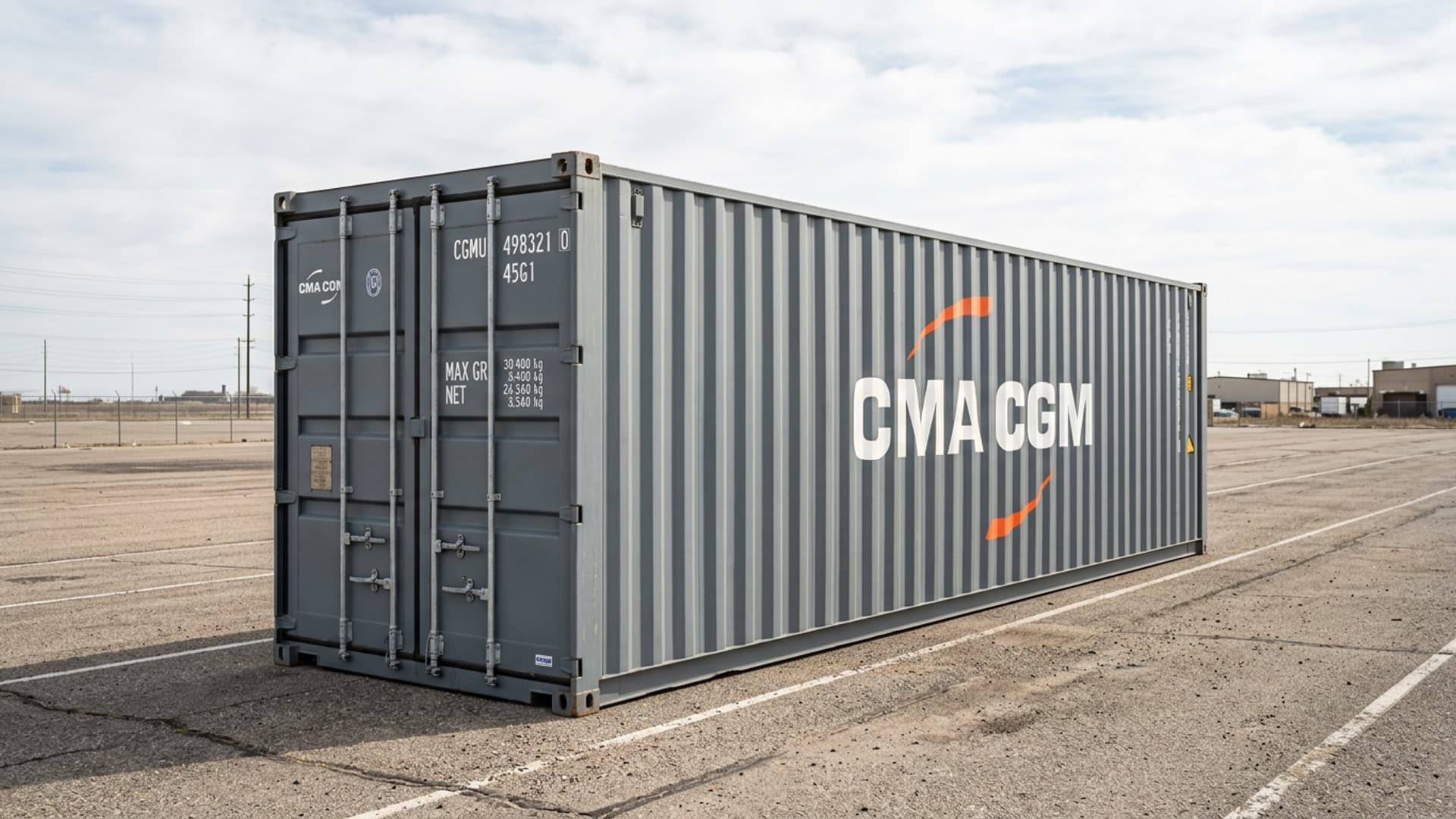
The volume format for a 40-foot shipping container
The 40-foot is the default choice when storage capacity exceeds 30 m³, and essential for habitable conversions (in its high cube version with an interior height of 2.69 m). Here are exact dimensions, prices in 2026, and comparison to two 20-foot containers.
Key Features
- External length
- 12,192 m
- External width
- 2,438 m
- External height
- 2,591 m
- Internal Height
- 2,390 m
Dimensions and capacities
| Characteristic | Standard dry | High cube |
|---|---|---|
| External length | 12,192 m | 12,192 m |
| External width | 2,438 m | 2,438 m |
| External height | 2,591 m | 2,896 m |
| Internal Height | 2,390 m | 2,697 m |
| Internal floor area | 28,3 m² | 28,3 m² |
| Internal volume | 67 m³ | 76 m³ |
| Tare weight | 3 600 – 3 800 kg | 3 800 – 4 000 kg |
| Maximum gross weight | 30 480 kg (indicative; check the CSC plate) | 30 480 kg (indicative; check the CSC plate) |
| Payload capacity | ~26 680 kg | ~26 480 kg |
Price 2026
| Status | 40 feet standard | 40 ft high cube |
|---|---|---|
| Brand new | £2,109 – £4,331 | £2,259 – £4,883 |
| One-trip | £1,958 – £3,780 | £2,109 – £4,253 |
| Grade A used | £1,456 – £2,993 | £1,607 – £3,308 |
| Grade B used | £1,155 – £2,520 | £1,305 – £2,756 |
| Grade C used | £954 – £2,126 | £1,054 – £2,284 |
Delivery to add: £368 – £1,050 depending on the zone. A 40 feet is longer to handle than a 20 feet — plan for a minimum access of 22 m and 4,5 m clearance height.
Available RAL colours
Frequently Asked Questions
What are the dimensions of a 40 feet?+
External (standard dry): 12,192 × 2,438 × 2,591 m. Internal: 12,032 × 2,352 × 2,390 m. Internal floor area: 28,3 m². Internal volume: 67 m³. The high cube version gains 30 cm in height (2,896 m external, 2,697 m internal) for a volume of 76 m³ — this is the preferred variant for converted living or office space.
How much does a 40 feet cost in 2026?+
Standard dry: £2,109 – £4,331 new, £1,456 – £2,993 Grade A used. High cube: £2,259 – £4,883 new, £1,607 – £3,308 Grade A used. Excluding delivery (£368 – £1,050 depending on zone — a 40 feet is heavier and more cumbersome to handle than a 20 feet).
40 feet standard or high cube: how to choose?+
A high cube leaves more allowance for insulation, flooring and ceiling. Choose using calculated finished height and the requirements for the actual use; high cube dimensions alone do not make a space compliant for occupation.
How many Euro pallets fit in a 40 feet container?+
22 Euro pallets (1.20 × 0.80 m) on the floor, 44 if stackable on two levels. 20 industrial pallets (1.20 × 1.00 m) on the floor, 40 on two levels. That’s almost double a 20 feet container — recommend a 40 feet for at least 20 pallets to transport or store.
Can a 40 feet container be delivered in an urban area?+
Urban delivery depends on vehicle dimensions, available width and height, turning space, parking and lifting equipment. Have the carrier verify the route and unloading plan. Check occupation permissions or restrictions with the local authority and require every surcharge in the quote.
Two 20 feet containers or one 40 feet?+
Common question. Advantages of two 20 feet: modularity (separate placement, independently movable), possibility to sell or rent one later. Advantages of one 40 feet: lower price per cubic metre, simpler logistics, uninterrupted space of 12 m (useful for long-term storage, workshops with long tools, open conversion). Compare offers with equivalent condition, equipment and delivery. The price difference depends on sellers and the project; no saving percentage is universal.
Also worth seeing
Price of a 40 feet container: 2026 barometer
Detailed purchase + rental grid for the 40 feet dry and high cube containers, 10 variants × conditions.
20-foot container
The all-purpose standard — 33 m³ usable.
High cube detailed
The 30 cm that change everything for conversion.
Used container
Classes A/B/C, points to inspect.
40ft container hire
Temporary need? Compare the monthly rates of a 40ft from £65/month.
45ft container
The size above: 86 m³, the largest standard.
Lever competition
You may receive up to 5 quotes depending on the container type, delivery area and available suppliers. The number of replies and response time depend on the partners; neither up to 5 quotes nor a fixed deadline is guaranteed.