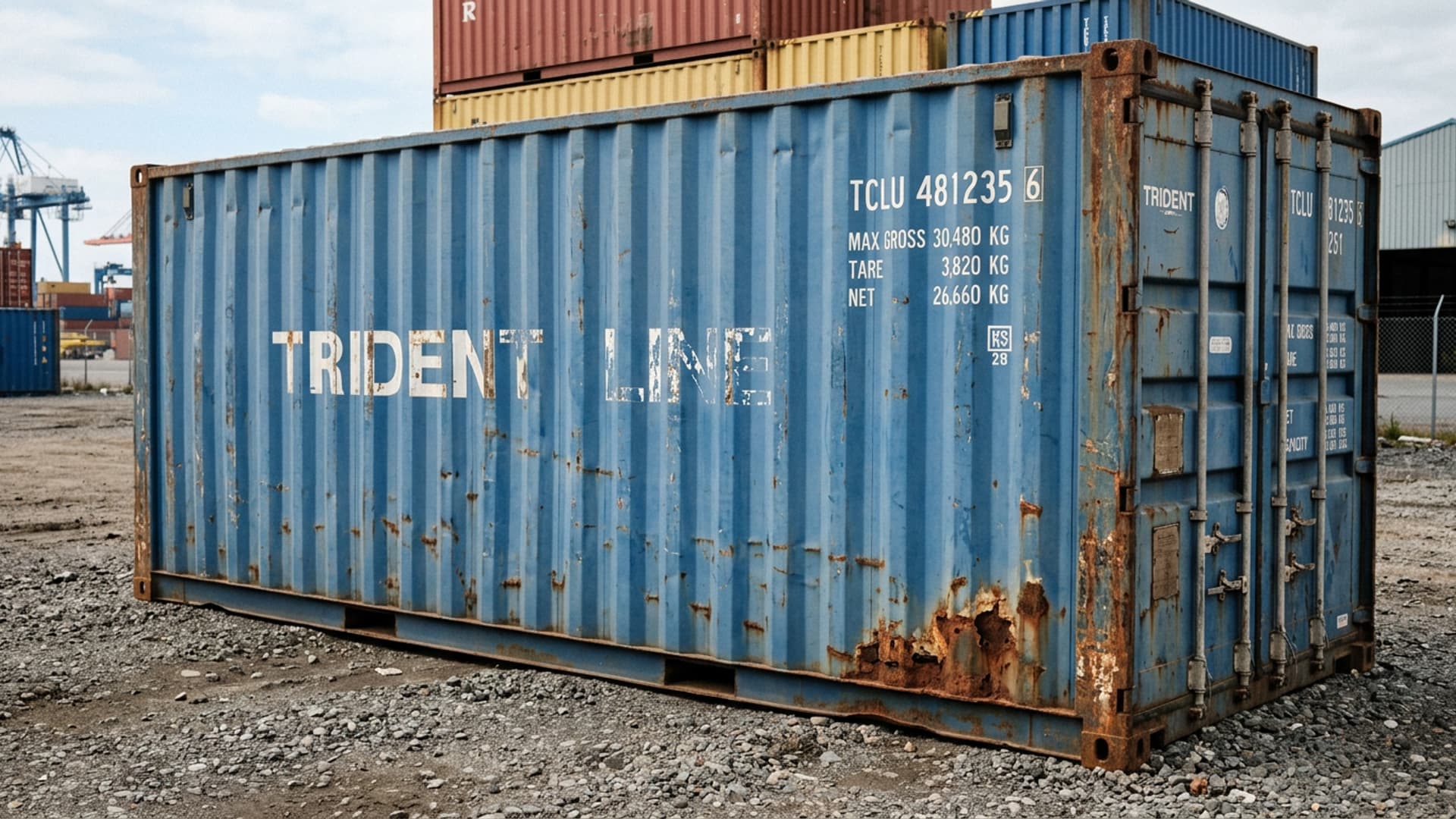
Used shipping containers: check the condition and compare prices
A used 20ft container costs from £702 (Grade C) to £2,205 (Grade A), excl. VAT and delivery: the trade grade A, B or C reflects its condition. Compare the actual unit offered and the delivered price; worn paint can be acceptable, but a damaged floor, stiff doors or undocumented repairs need checking.
Grades A, B and C: ask for the supplier’s criteria
These letters refer to commercial grading systems that can differ between suppliers. The descriptions below guide your questions rather than certify a unit. Indicative prices for a 20-foot container exclude VAT and delivery; compare written criteria, photos and repairs.
| Offered grade | Description to confirm | 20ft · excl. VAT | Choose for your needs |
|---|---|---|---|
| A | The best condition in the supplier’s grading system | £1,104 – £2,205 | Goods needing protection, with watertightness and floor checked |
| B | More visible marks or stated repairs | £904 – £1,890 | Storage where the defects suit the goods |
| C | More wear or work to be specified | £703 – £1,575 | A project after inspection and repair costing |
Inspect the unit: 7 points to check
Ask for recent exterior and interior photos of the container you are buying. Visit it or request a video of areas that are hard to see. If you spot a defect, ask the seller to explain it: photos alone cannot establish its cause.
Schematic drawing, not to scale, showing no actual container for sale. The numbers correspond to the checks below.
Floor
Look for stains, damage and repairs. Ask for close-up views and an assessment of weak areas for the loads you plan.
Roof
Request photos of the outside and ceiling. Water marks, corrosion or visible light need investigation; specify any repairs required.
Structure and corners
Look at distortion, cracks and repaired welds. Have anomalies assessed before deciding; a discount does not replace this check.
Doors and locking
Check operation of both door leaves, locking bars and alignment. Ask for resistance to be explained and adjustments or repairs specified.
Seals
Check continuity, cracks and contact when closed. Specify the agreed condition and any replacements.
Interior and history
Flag odours, residues and stains. Ask for available history, cleaning carried out and suitability for the goods you will store.
Identification and documents
Match the container number to the photos and quote. For sea transport, have the carrier confirm the documents and examinations required.
Match the photos, quote and delivered container
Compare the condition of your actual container. Agree identification, included work and handover arrangements with the supplier.
Identify the offered unit
Have the container number written into the quote and its photos attached. If the seller will choose your container later, agree which specifications and condition you will accept, and the terms for any replacement.
Describe the included work
Separate cleaning, painting, floor repair, seals and structural repairs. Ask what will be done before dispatch and request photos after the work.
Plan the handover
Confirm transport, unloading and positioning. At delivery, compare identification, condition and services; photograph discrepancies and contact the supplier under the agreed arrangements.
Compare what each quote includes
Two prices become comparable when the unit, condition and services are described on the same basis.
| Item | Price to separate | What to describe | What to confirm | Why it matters |
|---|---|---|---|---|
| Container | Unit only, excl. VAT | Size, grade and unit | Photos and accepted defects | Compare equivalent condition |
| Work | Included or separate | Cleaning and repairs | Result before dispatch | Assess the cost after repairs |
| Delivery | Transport and unloading | Depot, address and access | Who handles placement | Compare delivered cost |
| Handover and warranties | Options and charges specified | Unit documents | Written scope, duration and exclusions | Understand the supplier’s commitments |
Before choosing: compare the unit, work and delivered total. A discount on a unit needing repairs is useful only after assessing defects and the cost of putting them right.
Questions about buying a used container
What is a used container?+
A unit that has already been used, with its own condition and history. Check the actual container offered: age, paint and commercial grade are not enough to decide whether it suits storage, transport or conversion.
Do grades A, B and C mean the same thing everywhere?+
No. Ask each supplier for their grading system and compare their criteria for structure, floor, watertightness, doors and appearance. Record accepted defects and planned repairs: the letter alone does not make two offers equivalent.
How much does a used container cost?+
Indicative prices excl. VAT: 20ft Grade A £1,104 – £2,205, B £904 – £1,890, C £703 – £1,575; 40ft Dry A £1,456 – £2,993, B £1,155 – £2,520, C £954 – £2,126; 40ft High Cube A £1,607 – £3,308, B £1,305 – £2,756, C £1,054 – £2,284. Transport and unloading: £263 – £1,050, to be confirmed for your address. Options and repairs should be itemised in the quote.
What photos should I request before buying?+
Request recent views of the container number, all four sides, roof, floor, ceiling and doors open and closed. Add close-ups of defects and repairs. A video can show the doors closing; confirm that the images show the actual unit offered.
Which defects can make a low price less attractive?+
Scratches and worn paint differ from deep corrosion, floor damage, cracks or difficult closing. Have anomalies examined and repairs priced. Choose for your goods and the cost after work, rather than the discount alone.
What documents should I request?+
The quote or invoice should identify the seller, the container you are buying, its agreed condition and the included services. Ask for records of the work and the warranties offered too. For sea transport, the carrier must check the container’s documents and inspections.
What should I check at delivery?+
Compare the number, agreed condition, work and placement service. Photograph discrepancies and tell the supplier under the planned handover arrangements. Keep the quote, photos and delivery documents to follow up your request.
How should I compare warranties?+
Ask for the supplier’s written commitments: covered parts, duration, exclusions and the procedure if something goes wrong. Check whether repairs, transport or on-site work are included. Commercial grade or sales channel alone does not determine these terms.
Also worth seeing
Used 20-foot containers
Compact storage: compare condition, doors and floor.
Used 40-foot containers
Large capacity: plan access to the contents and delivery.
Used High Cube containers
Extra height: check the offered unit’s dimensions.
Used refrigerated containers
Request refrigeration unit history and a suitable test.
Used Open Top containers
Examine the tarpaulin, bows and offered unit’s structure.
Used Flat Rack containers
Confirm condition, securing points and handling equipment.
Used tank containers
Compare history, tank condition and available documents.
Brand new container
Compare manufacture, condition, equipment and delivered cost.
One-trip
Examine a recent unit and its handling marks.
Guide: new vs used
Choose by use, actual condition and full cost.
Compare used containers for your project
Specify size, expected condition and delivery address. You may receive up to 5 quotes, subject to supplier availability.