Pallets and bulk storage
Dense loading needs a planned unloading sequence. If you regularly need access to several product lines, leave passages and adjust the number of pallets.
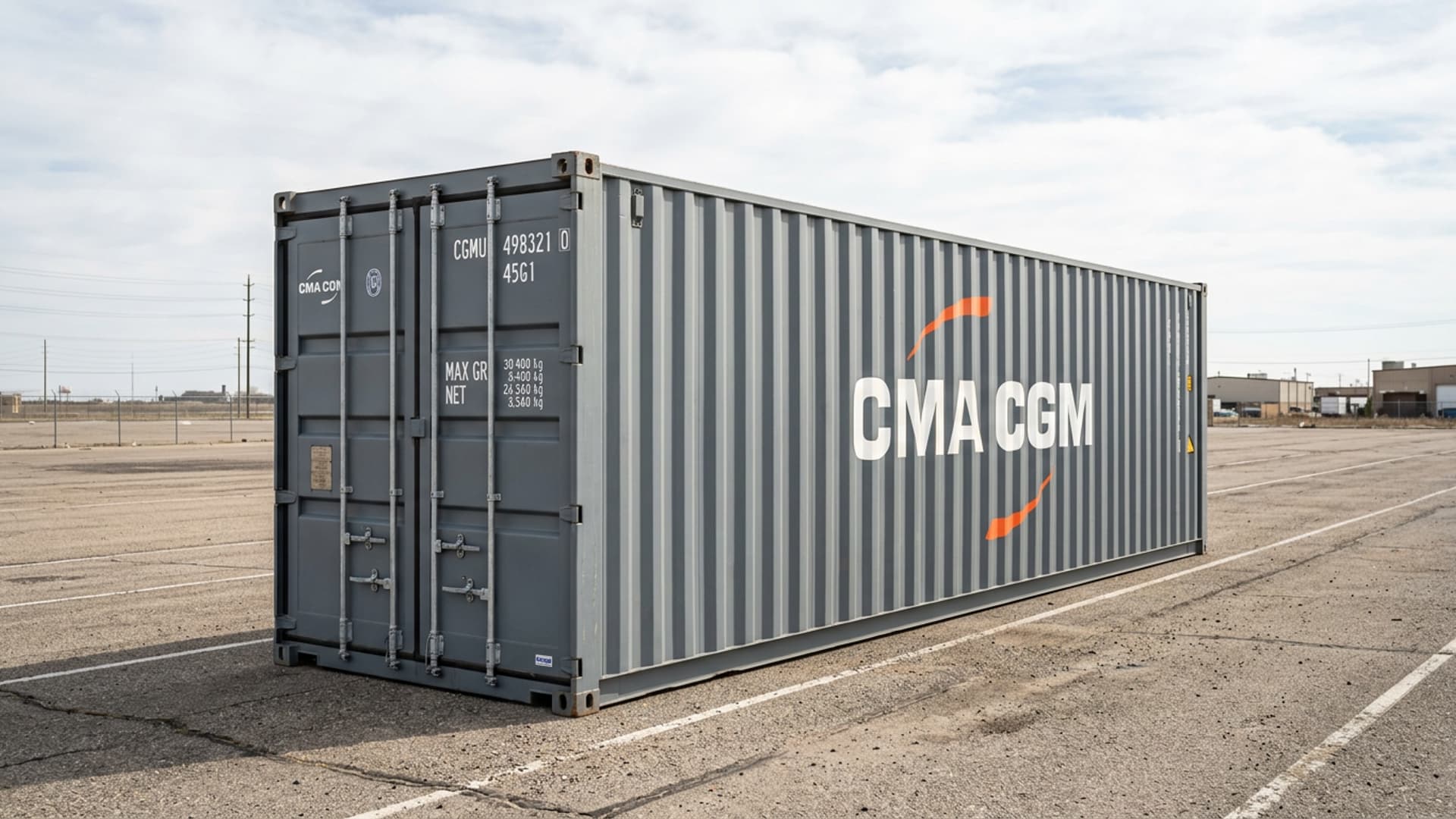
A standard 40ft container measures 12.192 × 2.438 × 2.591 m outside, with 28.3 m² of floor space and 67 m³ of usable volume (76 m³ in a High Cube). It gives one large continuous storage space, provided you plan delivery and access to the contents. Compare a Dry, a High Cube and two 20ft containers on full cost.
Key specifications
| Specification | Standard dry | High cube |
|---|---|---|
| External length | 12.192 m | 12.192 m |
| External width | 2.438 m | 2.438 m |
| External height | 2.591 m | 2.896 m |
| Internal length | 12.032 m | 12.032 m |
| Internal width | 2.352 m | 2.352 m |
| Internal height | 2.390 m | 2.697 m |
| Internal floor area | 28.3 m² | 28.3 m² |
| Internal volume | 67 m³ | 76 m³ |
| Tare weight | 3,600–3,800 kg | 3,800–4,000 kg |
| Maximum gross weight | 30,480 kg (indicative; check the CSC plate) | 30,480 kg (indicative; check the CSC plate) |
| Payload capacity | ~26,680 kg | ~26,480 kg |
| Door opening (width × height) | 2.343 × 2.280 m | 2.343 × 2.585 m |
Indicative prices excl. VAT and delivery. Compare Dry and High Cube containers in the same condition and with the same equipment; each supplier should state its used grades and included services.
| Condition | 40ft Dry | 40ft High Cube |
|---|---|---|
| New | £2,109 – £4,331 | £2,259 – £4,883 |
| One-trip | £1,958 – £3,780 | £2,109 – £4,253 |
| Used, Grade A | £1,456 – £2,993 | £1,607 – £3,308 |
| Used, Grade B | £1,155 – £2,520 | £1,305 – £2,756 |
| Used, Grade C | £954 – £2,126 | £1,054 – £2,284 |
Transport and unloading: allow £368 – £1,050, to be confirmed depending on the depot, distance and access. Have manoeuvring and placement checked before booking.
A 40-foot container provides around 28.3 m² of floor space and 67 m³ of usable volume. Plan both loading and access to your goods.
Euro pallet · 1 200 × 800 mm
This plan shows 25 pallets in two rows of 15 and 10, with no aisle or overhang. Confirm the offered unit’s internal dimensions and clear door opening: the margins can be tight.
Dense loading needs a planned unloading sequence. If you regularly need access to several product lines, leave passages and adjust the number of pallets.
Its length accommodates items too long for a 20-foot container. With shelving, check passage width, loads and the room needed to handle equipment.
Check that machines and packaged loads can pass through the doors. Allow space for handling equipment too: volume alone is not enough.
Compare actual condition using photos, according to the goods you will store and the appearance you want.
For a specific configuration, request details of manufacture, options and specifications. Clarify whether the offer is factory-new or one-trip.
A recent container may suit long-term storage. Inspect handling marks and the vulnerable parts of the actual unit.
Ask each supplier to define their grades. To protect your goods, examine watertightness, the floor and corrosion.
Have the selected condition, repairs and any commercial warranties included in the quote.
Compare capacity, storage layout and delivery arrangements.
| Configuration | Usable space | Choose it for | What to check |
|---|---|---|---|
| 40-foot DryExplore the 40-foot container | 28.3 m² · 67 m³ | One large continuous space and long equipment. | Access to the back and the site footprint. |
| Two 20-foot Dry containersConsider two 20-foot containers | Around 27.6 m² · 66 m³ in total | Separating uses or dividing your goods. | Two units, two access points and transport to compare. |
| 40-foot High CubeCompare the High Cube | Around 76 m³ | Tall goods or more vertical volume. | Item height, door opening and delivery. |
Compare included equipment and useful options, with an itemised price.
A lockbox shields the padlock and access to it. Check the system, its compatibility and the locking equipment supplied.
Check load capacity, threshold, slope and the space in front of the doors for your wheeled equipment.
Match it to the goods. Humidity management also depends on the air, loading and site.
An open-side model allows access from the side. Compare its clear opening, door movement and budget with a standard Dry container.
Have any modifications assessed for the specific model and use.
Have the intended position and access route assessed before booking transport. The vehicle and unloading arrangements must suit the site.
A standard Dry container measures 12.192 × 2.438 × 2.591 m externally, with indicative internal dimensions of 12.032 × 2.352 × 2.390 m. It provides around 28.3 m² and 67 m³. The High Cube has the same footprint, with an external height of 2.896 m and around 76 m³. Confirm dimensions and the door opening in the unit’s specifications, along with the permitted masses for your load.
Indicative prices excluding delivery: £2,109 – £4,331 for a new Dry and £1,456 – £2,993 for a used Grade A. For a High Cube: £2,259 – £4,883 new and £1,607 – £3,308 used Grade A. Allow around £368 – £1,050 for transport and unloading. Compare quotes that itemise condition, VAT, equipment and services.
A High Cube adds around 30 cm of height. It can be useful for tall items, shelving or a conversion where insulation reduces the available height. If your goods pass through the Dry’s doors and its height is sufficient, focus on condition and delivered cost. Neither variant is automatically needed for every project.
25 in theory: the plan shows 25 pallets of 1.20 × 0.80 m in rows of 15 and 10. Lengthwise margins are tight, with no aisle or overhang. Check the unit and load dimensions; a different layout or regular access can reduce the number. Stacking needs an assessment of height, weight and stability.
Often, but the haulier must assess access first: bends, vehicle length, obstacles, ground bearing capacity and the handling area. Send photos and a plan of the intended position. In town, time slots, permissions and unloading equipment depend on the site and local rules. Get the services needed priced before choosing the container.
It depends on how you use the space. A 40ft gives one continuous space about 12 m long; two 20ft containers let you separate uses and locations, with two access points. Their total floor area is similar, but transport, supports, equipment and site layout differ. Compare the full cost of both options in the same condition and with the same services.
Detailed purchase and hire prices for 40ft dry and high cube containers: 10 variants by condition.
The all-purpose standard — 33 m³ usable.
Compare usable height and budget with a standard Dry container.
Grades A/B/C and what to inspect.
Temporary need? Compare monthly 40ft hire rates from £65/month.
The size above: 86 m³, the largest standard.
Specify Dry or High Cube, condition, options and access at your address. You may receive up to 5 quotes, subject to supplier availability.