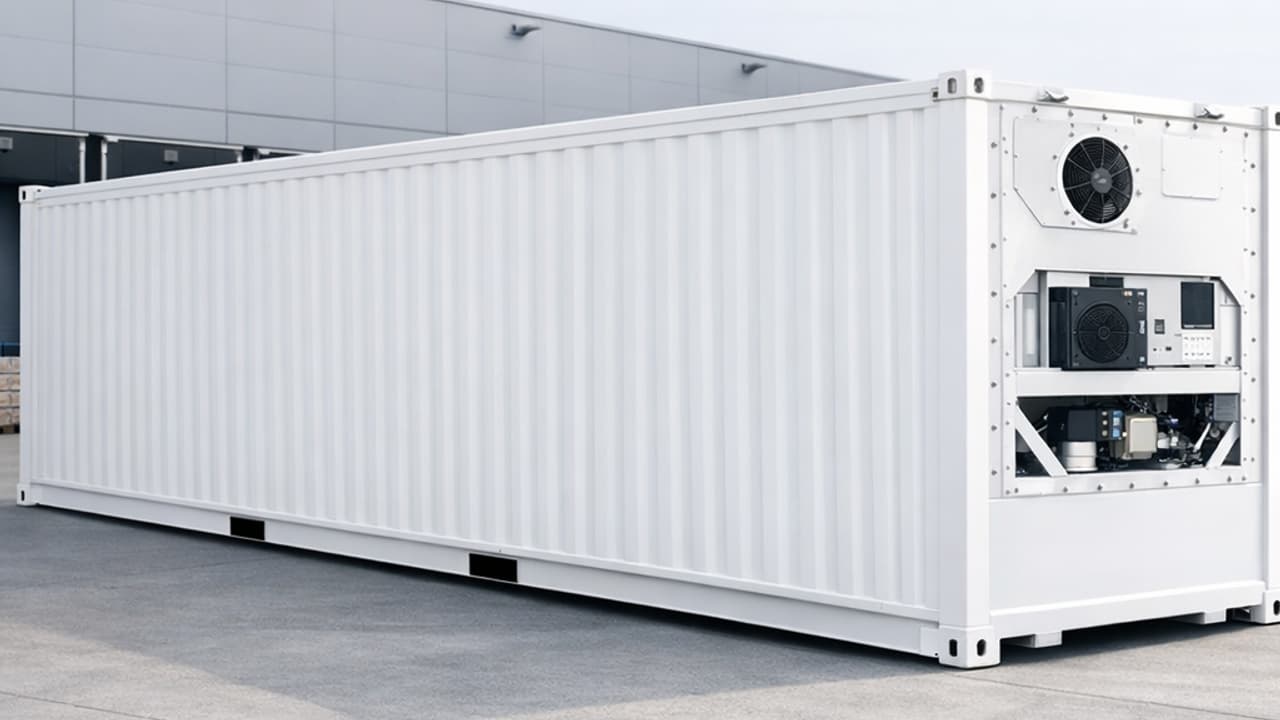
Refrigerated (reefer) containers: prices and how to choose
A reefer is an insulated container with an electrically powered cooling unit. To choose one, start from the volume to store, your products' temperature setpoints and the power available on site, then compare size, condition, price and included services.
Indicative purchase and rental prices
| Format | New purchase | Grade A used | Long-term rental |
|---|---|---|---|
| 20 ft reefer | £4,267 – £11,025 | £2,761 – £5,906 | £226 – £551/month |
| 40 ft reefer | £6,024 – £17,325 | £4,016 – £10,238 | £326 – £748/month |
| 40 feet high cube reefer | £7,028 – £19,688 | £4,769 – £11,813 | £377 – £866/month |
Indicative budgets excluding tax. Specify delivery, electrical connection, energy and maintenance services in the quote. Have the proposed unit’s power requirements checked against your supply.
Main uses
- Food and drink — storage with preservation requirements set by the person responsible for the products. Specify packaging and loading frequency.
- Pharmaceuticals and healthcare — projects requiring qualification for the products and operating conditions; an adjustable temperature alone is insufficient.
- Events — temporary capacity with access, power supply and support arranged for the event’s duration.
- Laboratories and R&D — controlled-temperature requirements agreed with the person responsible for the products and project service providers.
- Industrial backup — additional storage during a peak or outage, with handover and support arrangements agreed in advance.
- Sea freight — equipment and loading to be checked by the carrier for the cargo and journey.
20ft or 40ft High Cube: how much space is available?
Insulation and the cooling unit reduce the space compared with a dry container. These indicative dimensions help compare internal floor space and door clearance; confirm the measurements of the unit offered.
| Example | Internal length × width | Door opening (W × H) | Calculated floor area · published volume |
|---|---|---|---|
| 20ft reeferIndicative dimensions | 5.450 × 2.280 m | 2.290 × 2.264 m | 12.4 m² · 28.1 m³ |
| 40ft High Cube reeferIndicative dimensions | 11.599 × 2.290 m | 2.290 × 2.557 m | 26.6 m² · 67.7 m³ |
These dimensions are examples from fleet models, not a guarantee for the container offered. You cannot fill all the stated volume: check the loading-height limit, space for airflow, permitted load and packaging. For a standard-height 40ft reefer, ask for that model’s specification.
Loading: allow the air to circulate
Cooling must reach the load. Have the supplier confirm packaging and stowage; do not automatically reuse a Dry container pallet layout.
- Refrigeration unit
- Illustrative cargo
- Airflow principle
- Indicative load limit
This drawing explains the principle; it is not to scale or a manufacturer’s loading plan. Follow your container’s markings and instructions. The person responsible for the products must confirm their temperature before loading and the required settings.
Four details to include in your quote request
- Product setpoint, tolerance and storage duration.
- Packaging dimensions, weight and door-opening frequency.
- Available power supply and container location.
- Required tests, temperature monitoring and support.
Electricity: calculate a scenario, then replace its inputs
This example uses assumed inputs, not a stated consumption figure or market tariff. Replace them with a measurement suited to your use and your contracted electricity price.
- Assumed daily consumption
- 60 kWh
- Assumed unit price
- £0.20 / kWh
- Scenario duration
- 30 days
- Energy only for this scenario
- 60 × £0.20 × 30 = £360
Example excluding tax, standing charges, connection and generator costs. Setpoint, weather, door openings and unit condition affect consumption. Request a test or measurement under your intended conditions.
Plan the power supply and electricity budgetUsed reefers: evidence to request before choosing
Assess refrigeration unit, insulation and structure together. Ask for year, maintenance history, PTI report and tests appropriate to project setpoints and conditions. Appearance alone establishes neither performance nor remaining life.
- Container identification and exact refrigeration-unit model.
- Available maintenance history, repairs and alarm records.
- An identified test or PTI report, followed by a test at the agreed setpoint.
- Seals, panels and floor condition; contractual support and exclusions.
Documents and tests for your intended use
These checks have different purposes: CSC concerns container transport safety, ATP concerns covered perishable-food journeys and equipment, and PTI checks refrigeration-unit operation. Determine which applies to the intended use.
CSC Certification (Convention for Safe Containers)
For international transport subject to CSC, check the actual container’s safety plate and examination records. Under the periodic scheme, the first examination is due within five years of manufacture, then at intervals no longer than 30 months; an approved continuous examination programme (ACEP) is an alternative with regular operational checks. Confirm the carrier’s requirements. CSC does not certify food suitability or approve a container building.
ATP: perishable-food transport agreement
ATP concerns the covered perishable foods carried internationally by road or rail between contracting states, including qualifying short sea crossings. It is not triggered merely by moving an empty reefer on a truck or using it for static storage. Check the equipment class, food temperatures, route and national domestic rules. Initial approval can last up to six years; qualifying subsequent checks can extend it by three years. Follow the actual certificate and national procedure: there is no universal ATP annual-inspection requirement.
PTI (Pre-Trip Inspection)
A PTI (Pre-Trip Inspection) is an operational check under the refrigeration-unit manufacturer’s procedure, not CSC or ATP approval. Request a dated report identifying the unit, tests, alarms and results, and a test at your required setpoint before commissioning. Scope, duration and price depend on the model and service provider; there is no universal statutory three-month PTI validity.
Before accepting the equipment: Confirm the documents required for your cargo, journey and static use with the competent authority and carrier. Missing required approval can prevent acceptance for the intended transport. Check insurance coverage and exclusions in the actual policy; a certificate or PTI alone does not guarantee coverage or cargo performance.
Available RAL colours
Reefer containers: frequently asked questions
What is a refrigerated container?+
A reefer combines an insulated enclosure with an electrically powered refrigeration unit. Its settings range, power supply and functions depend on the model. Request the offered unit’s specification and the tests needed for your requirements, rather than choosing from a generic temperature range.
How much does a refrigerated container cost?+
Indicative purchase prices: £4,267 – £11,025 for a new 20ft and £6,024 – £17,325 for a new 40ft; used Grade A: £2,761 – £5,906 (20ft) and £4,016 – £10,238 (40ft), excluding delivery. Ask for the cooling unit's condition, equipment, connection, VAT and services to be specified in the quote.
How can I estimate electricity consumption?+
Use measured kWh or a justified estimate for your model, setpoint and conditions. Multiply daily kWh by your contracted price per kWh and the duration. This page’s example is an assumed calculation, with no consumption guarantee. Connection capacity and billed energy are different quantities.
What if the site has no suitable power supply?+
Have the relevant providers check voltage, connection, protection and required capacity. A temporary supply must suit the proposed unit and operating conditions. Ask for a budget covering any generator hire, energy or fuel and support; the solution depends on the site.
Should I buy or hire a reefer?+
It depends on how long and how often you need it. Compare financing, transport, maintenance and breakdown support: hire may include some services (check the contract), while owning means arranging upkeep yourself.
Can a Dry container be converted into a cold room?+
It can be, but the conversion must be assessed for usable volume, insulation, cooling unit, power and intended use. Ask for a full quote and compare it with a suitable reefer or cold room: performance and total cost cannot be inferred from the price of the Dry container alone.
What evidence should I request for a used reefer?+
Ask for a dated PTI report or manufacturer-approved operating checks for the offered unit, maintenance history and a test at the required setpoint. Inspect doors, seals, insulation, corrosion and alarms. For international transport subject to CSC, verify the safety plate and current examinations or ACEP; for covered perishable-food carriage, check ATP separately. A recent compressor replacement alone does not guarantee future service life.
When should I choose a two-zone reefer?+
If two temperature requirements must be maintained simultaneously, compare independent zones with two separate units. Confirm controls, volume per zone, access and test results. A partition alone does not establish this capability; compare price and consumption for the actual model.
Also worth seeing
Price of refrigerated container: barometer 2026
Reefer grid for 20' and 40', monthly electrical cost, cooling unit selection.
Renting a reefer
Monthly rates, use cases pharma/agro/event, electricity included.
Reefer electricity
Three-phase 415 V (BS 7671), kVA sizing, generator.
Reefer vs cold room
TCO comparison, mobility, flexibility.
Need a mobile cold chain?
Up to 5 quotes from reefer specialists, subject to supplier availability.